

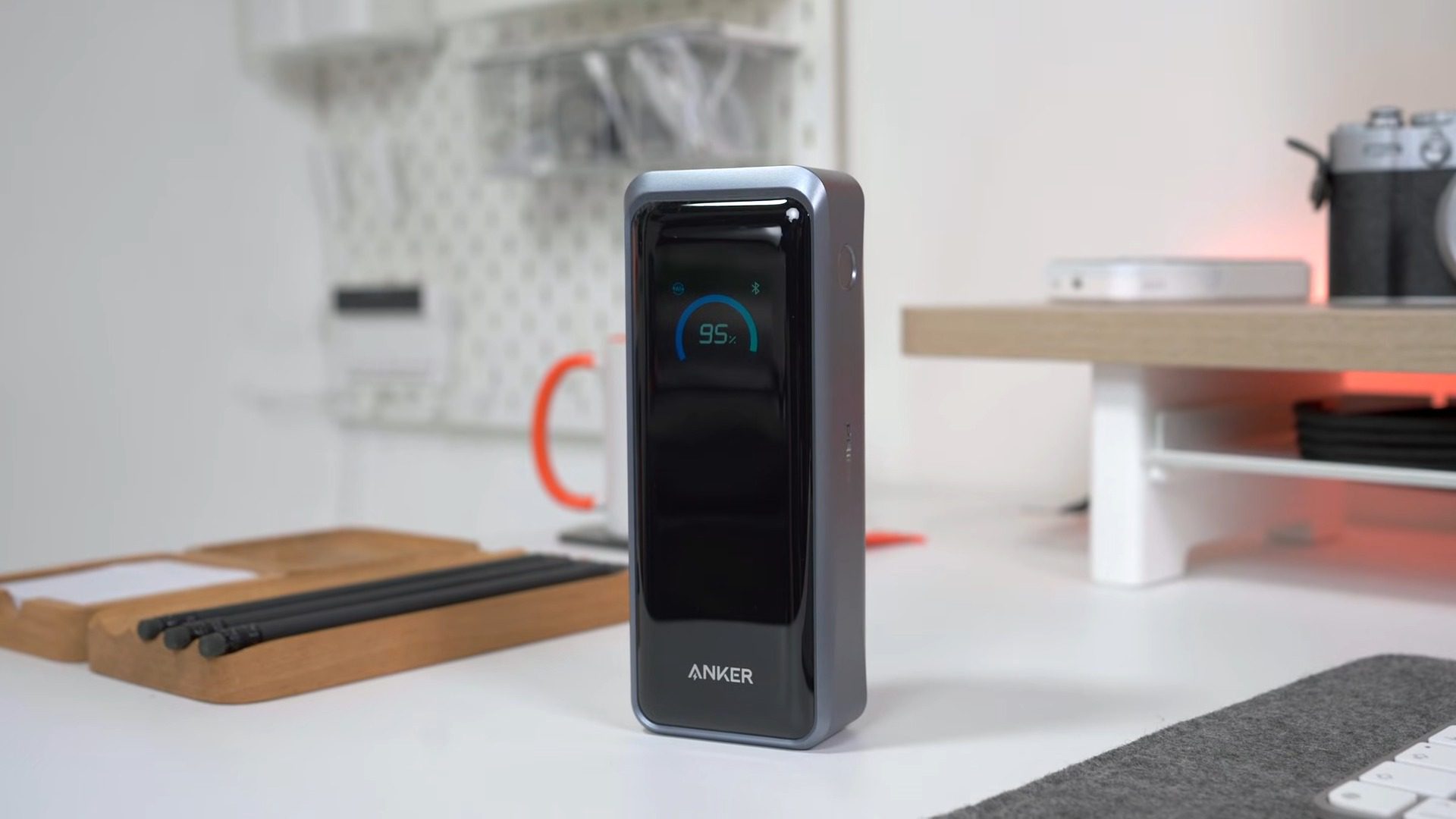
This is Anker’s newest and most powerful daily power bank, a device that stands out in the market of portable charging. We are looking at a 26K capacity model that promises multiple recharges for smaller tech and a massive 300W of total output. It is designed to be smaller and lighter than its predecessor while maintaining the ability to top up two MacBook Pros at full speed. This is a serious piece of equipment for anyone who needs reliable power on the go, although it comes with a premium price tag of around $230.
You get a fresh design that feels modern, a new smart display, and some staggering input speeds. I have tested this thoroughly with an iPhone 17 Pro Max, an iPad Pro, and a MacBook Pro to see how it handles real-world demands. While it is certainly overkill for the average user, the performance figures suggest it is in a league of its own.

A Refreshed Geometric Design
Straight away, you will notice the refreshed look of the new 26K. The sides now feature a geometric styling at the top and bottom, giving the unit a more modern feel compared to the older generation. It is also less chunky, measuring 16x6x4 cm and weighing about 600g. There is a shiny new Prime logo on the side, adding to the premium aesthetic.
However, the front retains that full glossy black plastic finish. I do like how it looks when it is clean, but just like the old model, it picks up fingerprints and scratches easily. You will find yourself wiping this thing down often to keep it looking gorgeous.

Up on top, we have a familiar set of ports: two USB-C ports and one USB-A port. I know some people would prefer a third USB-C port, myself included, as I often find myself cycling devices between the two available C ports. However, I understand why the USB-A port is still hanging on for those with legacy devices.

Underneath, there is a redesigned Pogo pin connector that supports faster charging when paired with the new base, and on the side, the standard button to wake up the smart display remains a staple.
Smart Display and User Interface
The smart display has seen some solid updates. It is larger, and the UI has been refreshed to match Anker’s other recent releases. A nice touch is the built-in accelerometer, which automatically rotates the display as you turn the device.
You get all the essential information: battery percentage, input and output for each port, battery temperature, and Bluetooth status. The text is larger, and the graphics are clearer, making it perfectly legible even under bright studio lights.

One significant change is the removal of the time remaining estimate. The previous model used to count down how long the power bank would last based on the current output. I suspect Anker ditched it because people often confused it with the time required to fully recharge their connected device. While I can see why they removed it to avoid confusion, it was a feature I used. Now, you just get the essentials without the guesswork.
Battery Capacity and Flight Regulations
You might notice that the new 26K is listed at 26,250 mAh, which looks like a step down from the older model’s 27,650 mAh on paper. In reality, that is not the case. The newer cells run at a higher voltage. When you look at the Watt-hours (Wh), the new model comes in at 99.75 Wh compared to the old model’s 99.54 Wh. Technically, the new one has a touch higher capacity. This distinction is crucial because Watt-hours tell you the actual energy available.

This specific capacity is intentional. Airlines typically cap batteries at 100 Wh for carry-on luggage. Anker has squeezed in the biggest possible battery while keeping it legally compliant for air travel. So yes, the new Prime is fine to take in your carry-on, but you should always double-check your airline’s specific rules before you fly.
Real-World Charging Tests
My testing with the iPhone 17 Pro Max yielded impressive results. It went from 1% to 50% in just 22 minutes, and a full charge took under an hour and a half, leaving the power bank with 73% remaining. That is roughly three full iPhone charges.
On my 13-inch iPad Pro, it hit 50% in about 27 minutes, with a full charge taking a little over two hours. The bank still had 41% left, providing almost two full charges for a large tablet.

For laptops, my 16-inch M1 Max MacBook Pro went from 0% to 79% in just under 50 minutes before the power bank ran out. It is worth noting that you won’t get a full MacBook Pro charge due to energy loss—around 30-45% is lost as heat. Despite this, the power bank never pushed past 41°C during testing. It manages heat well, though heavy users on a hot day might see different results.

Input and Output Power Delivery
Speed is the main selling point here. The 26K boasts a max total output of 300W when using all ports. For the first time, you can get the maximum output for each port regardless of how many devices are plugged in: up to 140W from each USB-C port and 22.5W from the USB-A. In theory, you can fast charge two MacBook Pros at full speed simultaneously. That is crazy power delivery that ensures you are never in danger of slow charging as you plug in more gear.
Input speed has also received a major upgrade. While single-port input is still 140W, dual input charging has jumped from 170W to a massive 250W. You can literally watch the numbers climb in real time. In my test, it went from 0% to 100% in just 1 hour and 13 minutes. From empty to 50% took only around 15 minutes. This speed means you don’t have to leave it charging overnight; a quick top-up while getting ready is often enough.

The New Charging Base Experience
The optional charging base has been redesigned, meaning the new 26K will not work on the older base. The upgrade is valid, however, as the pogo pins are now 50% faster, jumping from 100W to 150W charging when docked. The base itself has a matte finish, replacing the old glossy one, which looks cleaner and is far less prone to smudges. Instead of a screen, you get an animated light strip for status updates.
The base includes two USB-C ports and one USB-A port on the side. With all outputs in use, the pins max out at 75W. It is a solid performance upgrade that adds convenience—you can just drop the Prime on it at the end of the day and grab it when you leave. The only trade-off is that the new base is larger and takes up a bit more desk space.

App and Software Features
This power bank features Bluetooth and connects to the Anker app, acting as an extension of the smart display. You get real-time graphs for input and output, allowing you to spot power spikes or dips. You can toggle between wattage, amps, and voltage for detailed data. However, the app only shows data from the moment you open it; you cannot scroll back to see historical data.
Through the app, you can update the firmware, change charging modes, and even set a Pomodoro timer. The default “Smart Dynamic Allocation” mode is best for most users, but “Custom Mode” lets you set your own limits. Sadly, a few features are missing: you can no longer play a sound to find the device, and the estimated charges feature that let you calculate device recharges is gone. I hope these return in future updates.

Final Thoughts — Price & Value
The Anker Prime 26K comes in at around $230, with the charging base costing an additional $100 or so. It is undeniably a pricey upgrade, and you are paying a premium for those high-speed features. If you are a power user who needs to charge multiple high-drain devices like MacBook Pros simultaneously, the 300W output and 250W input speeds offer incredible value and convenience.
For most people, however, this device is overkill in the best possible way. You likely won’t push it near its limits day-to-day. The older model is still an excellent buy and has been dropping in price lately. Unless you specifically need the dual laptop fast charging or the 250W recharge speed, the previous generation remains a more cost-effective choice for general use.
