

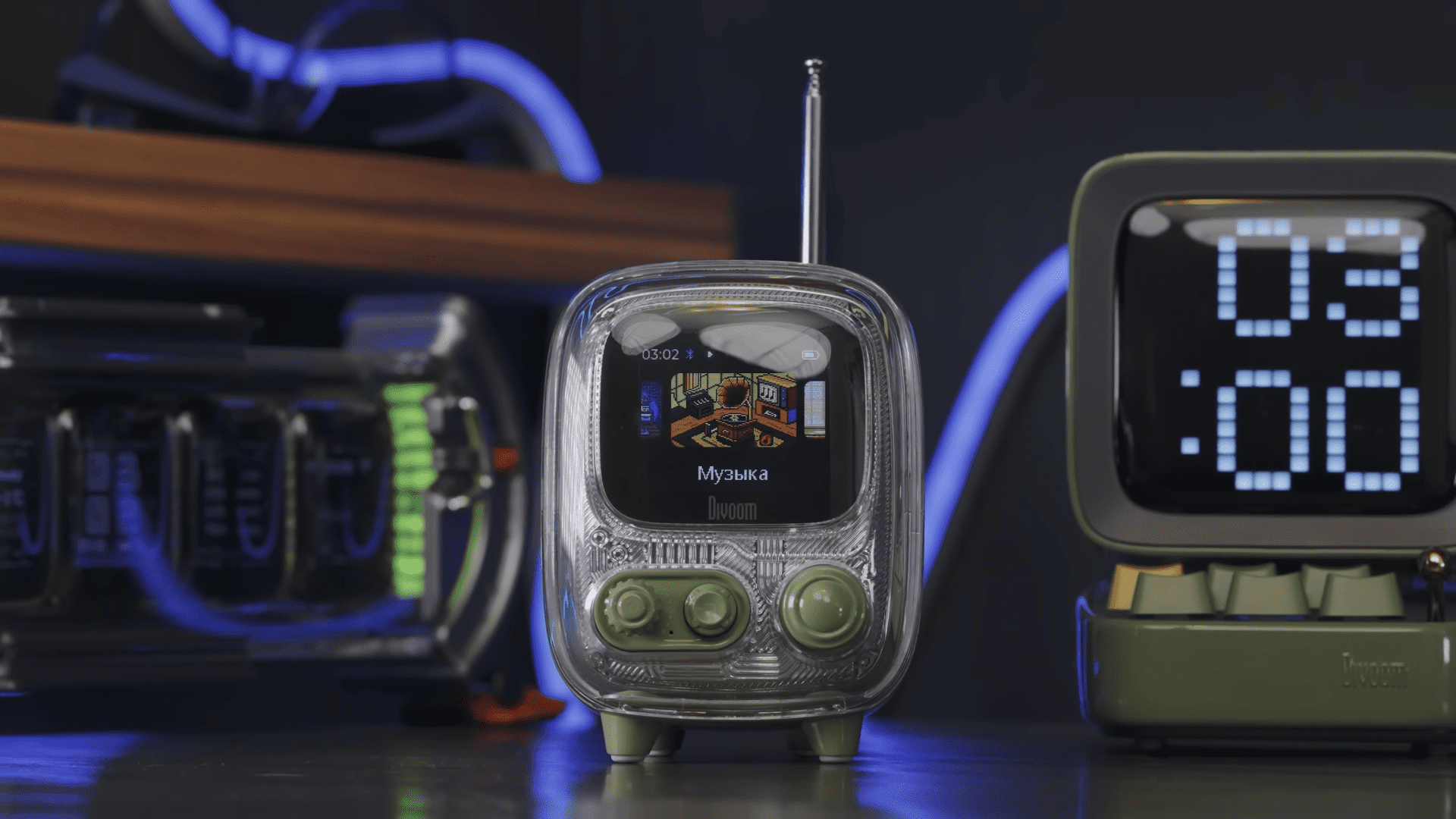
The Divoom Tivoo-2 presents itself not merely as a speaker, but as a compact multimedia center designed to enhance the atmosphere of a room. Manufacturer marketing highlights a plethora of features, including a 40.5mm broadband driver, a 2000mAh battery, and a retro-pixel LED screen capable of displaying custom animations. You have likely seen this device circulating on various social media platforms, often touted as the ultimate desk accessory.
My objective here is to strip away the viral marketing and determine how this device actually performs in a real-world setting, specifically regarding its audio output and functional versatility.

Pricing for this unit tends to fluctuate depending on whether you are browsing AliExpress or Amazon, but it generally falls into the category of affordable tech gifts. It claims to deliver balanced sound for small spaces with a power output of 5W and a frequency range of 90 Hz to 20 kHz. Beyond audio, it promises utility through features like an alarm clock, games, and voice memos. I have spent significant time testing the “Divu 2” to see if the reality matches the specifications on the box.
Retro-Inspired Design
The device arrives in a branded cardboard packet followed by a primary plastic casing featuring a rubberized handle and a transparent front section. This packaging design is impressive and mirrors the aesthetic quality of the device itself, displaying the name and brief specifications clearly. Inside the box, the kit includes the Tivoo-2 securely fixed in place, a quick user guide, a set of stickers, and a branded braided USB cable measuring 80 cm in length.

Physically, the speaker is compact and relatively substantial for its size, weighing in at 296 grams. The dimensions, excluding the antenna, measure 78x71x73 mm, making it a very unobtrusive addition to a desktop setup. The housing is constructed from durable, high-quality plastic with a glossy finish, which gives it a premium look but unfortunately acts as a magnet for fingerprints. The front features a transparent plastic insert, while the rest of the body maintains a standard solid color, available in pink, yellow, green, and black variations.
Design choices here clearly favor a retro atmosphere, mimicking the look of an old-school television set. I found it serves excellently as a decorative element for a workspace, rather than a rugged portable speaker for outdoor excursions.

The device sits on four legs equipped with anti-slip inserts, ensuring stability on smooth surfaces. A telescopic antenna adds to the vintage charm; it measures 80 mm when retracted and extends up to 250 mm, and can be fixed in various positions to aid radio reception.
Build quality appears solid, with neat seams and no noticeable backlash or rattling parts during handling. On the side, you will find a USB-C port for charging and a slot for a microSD card, supporting capacities up to 64GB. The inclusion of a physical antenna and the specific form factor reinforce that this device is intended primarily for indoor, stationary use, perhaps connected to a laptop via cable to serve as an external speaker.

Pixel Display Functionality and On-Board Controls
Central to the Tivoo-2’s appeal is its LED display, which features pixel graphics and measures approximately 35×26 mm. The screen is sufficiently bright, and the pixel art looks harmonious within the chunky bezels that frame it. While the bezels are large, they do not detract significantly from the experience, fitting the retro TV aesthetic perfectly.
Upon powering on the device, users are presented with a main menu containing ten primary tabs, displaying essential information such as connection type, time, battery level, and music playback status.

Navigating the interface relies on a set of physical controls: a mechanical button, a joystick that supports clicking, and a rotary knob or “crown.” Standard commands allow you to move through the interface, switch audio sources, and control playback with ease.
However, the rotary crown used for volume control lacks the precision one might desire. I often found myself needing to turn it very carefully to avoid skipping past my intended volume level, which can be slightly frustrating during daily use.

The menu system is quite deep for a simple speaker, offering tabs for Bluetooth, memory card playback, USB connection, and radio. Settings allow for adjustments to screen brightness, sound, screen timeout, and auto-shutdown timers. While the translation in the menu is occasionally incorrect, the functions remain understandable.

Multimedia Capabilities
One of the standout features of this model is its integrated FM radio, which utilizes the telescoping antenna for signal capture. My testing revealed that the radio functions without issues, picking up numerous stations with stable reception quality. The interface allows for both automatic and manual searching, and you can save a list of favorite stations for quick access.
File support for local playback is surprisingly robust. The Tivoo-2 can read a wide variety of audio formats from a microSD card, including MP3, FLAC, WAV, AAC, M4A, WMA, and AIF. This flexibility is a significant plus for users who prefer high-quality local files over streaming. The dedicated “Atmosphere” tab adds another layer of utility, offering fifteen pre-installed animations and a slideshow mode that can be customized with personal photos.

Beyond audio, the device includes a “Tools” tab populated with fifteen different games, including classics like Tanks, all optimized for the low-resolution pixel screen. Additional utilities include a “Wheel of Fortune,” standard timers, a stopwatch, and a scoreboard for competitive games. There is even a noise measurement tool and a voice memo function, which utilizes a fairly sensitive microphone that records voice clearly without the need to shout.

Mobile Application and Creative Pixel Art Features
Connecting the Tivoo-2 to the proprietary Divoom app unlocks the full potential of its display and customization options. The application mirrors many settings found on the device but provides a much more intuitive interface for managing notifications, weather displays, and reminders. A somewhat confusing “frame style” setting is available, though its practical utility seems limited. The app also includes a synthesizer and a sampler, adding a creative audio dimension for those interested in making music.

Creating and downloading pixel art animations is the primary reason to use the application. It features a robust editor for designing custom images and animations, and even includes an AI-assisted creation tool that works surprisingly well.
Users can access a massive gallery of works from other users, engage in a community chat, and maintain a personal profile. For entertainment, there is a pixel coloring book feature, which can be a relaxing way to pass the time.

Despite the rich feature set, the application experience is not flawless. I noticed that advertisements for other Divoom products can be intrusive within the app interface. However, the ability to use the smartphone as a controller for the games on the speaker is a clever integration. The synchronization between the phone and the speaker is generally reliable, allowing for seamless updates to the display art and settings.
Audio Quality
Audio performance is generated by a 40.5mm full-range driver paired with a passive radiator, delivering a total output of 5W. Given the small physical footprint and the gimmick-heavy nature of the device, I anticipated poor sound quality, but the Tivoo-2 actually delivers a balanced audio profile. The frequency response ranges from 90 Hz to 20 kHz, which naturally means deep sub-bass is absent. This is not a device for “bassheads,” but the sound remains coherent and enjoyable for casual listening.

Mid-range frequencies are well-developed, ensuring that vocals and instruments are clear and distinct. Detailed listening reveals that the sound remains clean without becoming a muddy mess up to about 75% volume. Pushing the volume higher can introduce some compression, but at a distance of one meter, the speaker produces a respectable sound pressure level of around 90 dB. It performs admirably as a background music source for a workspace, kitchen, or hobby area.
A significant acoustic flaw I observed is the presence of “white noise” or hiss when the device is idle or playing at very low volumes. This background hiss can be irritating for sensitive listeners, particularly in a quiet room. Despite this, the sound signature remains consistent across different modes, which is a positive attribute. It effectively functions as a near-field speaker, but it lacks the power to fill large rooms or parties.

Connectivity and Battery Life
Connectivity is handled via Bluetooth version 5.3, supporting SBC and AAC codecs. The connection remains stable during use, and the device supports automatic reconnection to previously paired sources. Unfortunately, it lacks Multipoint support, meaning you cannot connect two source devices simultaneously. For video content, the latency is minimal; watching movies or YouTube clips reveals no distracting desynchronization between video and audio.
Gaming latency presents a different scenario. When connected to a smartphone for fast-paced shooters, the delay becomes noticeable. For gaming purposes, I recommend utilizing the USB-C wired connection to the PC or phone to eliminate latency entirely.

Power is supplied by a 2000mAh battery, which the manufacturer claims offers up to 8 hours of autonomy. In my practical testing, with volume set between 50% and 65%, the speaker averaged around 6.5 hours of playback time. Recharging the unit is a slow process, taking approximately 3.5 hours to go from 0 to 100%. While the battery life is adequate for a day at the desk, the slow charging speed is a drawback that users will need to manage.
Final Thoughts — Price & Value
The Divoom Tivoo-2 occupies a unique niche in the tech market, functioning more as a piece of functional decor than a dedicated audio powerhouse. Its value proposition lies heavily in its aesthetic appeal, the retro charm of the pixel art display, and the novelty of its extensive feature set. While the audio quality is balanced and clear for its size, it naturally falls short of larger, similarly priced speakers that lack a screen. The “white noise” issue at low volumes and the glossy, fingerprint-prone body are valid criticisms that potential buyers must consider.

For those seeking a pure listening experience, brands like Anker Soundcore offer better audio performance in this price bracket. However, the Tivoo-2 offers a “vibe” that standard speakers cannot match. It serves excellently as a gift or a desk companion that adds character to a room, offering tools like the Pomodoro timer and notifications that genuinely aid productivity. The ability to customize the visual experience through the app ensures the device remains fresh and interesting long after the unboxing.
