

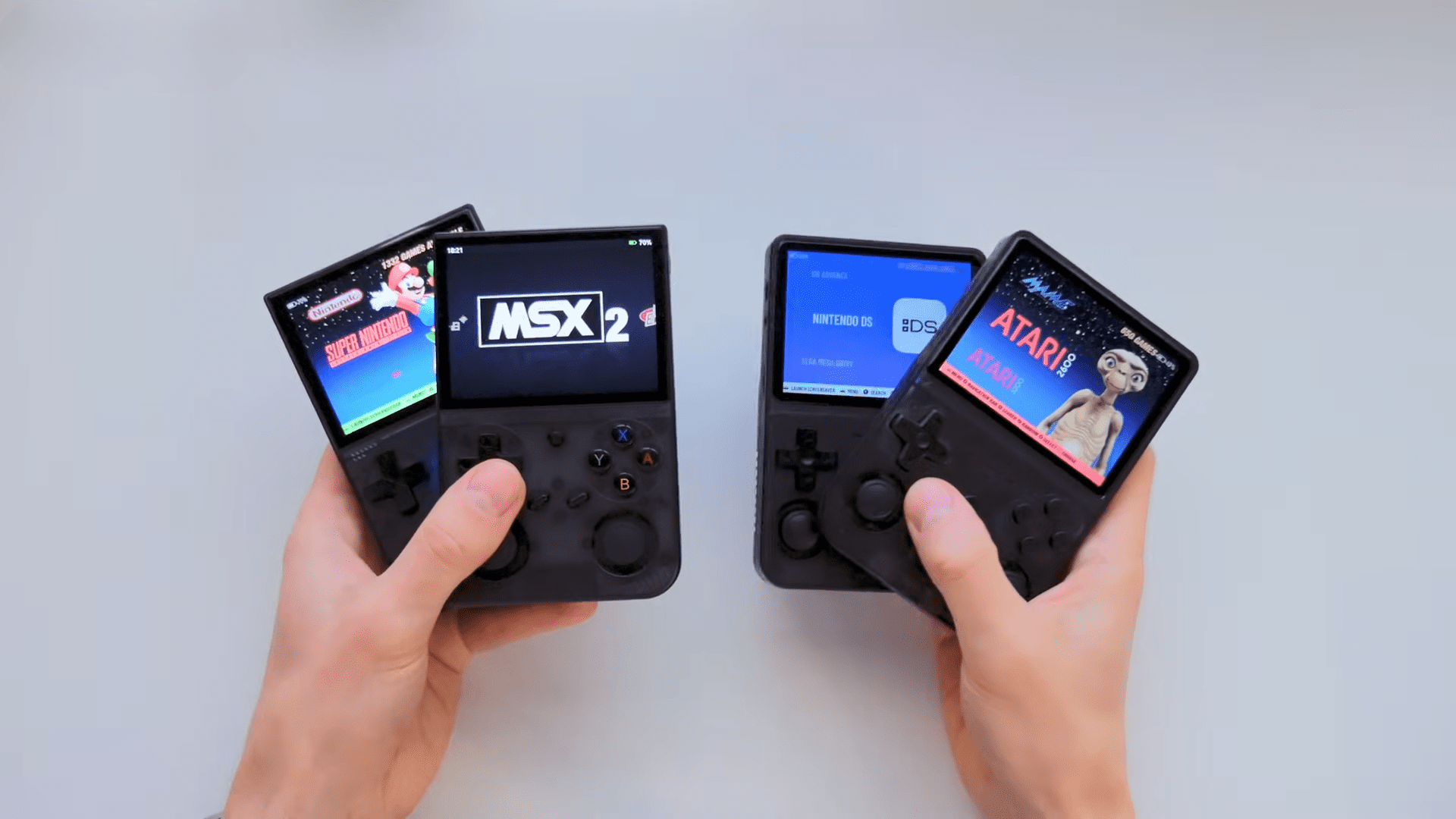
The marketplace for budget retro handhelds has evolved into a chaotic battleground, reminiscent of a clone war where identifying the superior device requires a keen eye. Currently, four distinct consoles dominate the conversation, all looking suspiciously similar yet hiding vastly different capabilities under their shells. I have gathered the R36S with the v22 board and Panel 4 screen, the Gaminja ANS11 (a clone utilizing a v12 board), the Kinhank K36, and the BatleXP G350.
These devices generally retail in the ultra-budget bracket of $20 to $45 on AliExpress, with prices fluctuating based on seasonal sales and specific vendor discounts. While they share a form factor, they are fierce competitors often marketed deceptively as the original R36S to capitalize on its massive community support and price-to-performance reputation.
Navigating this landscape is treacherous because sellers often list inferior clones under the guise of the popular “people’s console.” To cut through the noise, I established a rigorous four-point scoring system to rank these devices objectively across design, ergonomics, and raw performance.
My goal is to determine if the original R36S retains its crown or if a contender like the G350 has usurped it. I also intend to answer a pressing question for 2026: is the discomfort of owning a clone worth the potential savings, or is it a fast track to frustration? We will dissect the hardware, push the RK3326 processors to their limits, and see which black transparent slab deserves a spot in your pocket.

Shell Ergonomics and Tactile Build Quality
To ensure a fair visual comparison, I purchased every console in a transparent matte black finish. Touching the G350 immediately revealed a disparity in manufacturing standards; it possesses the highest quality plastic by a significant margin. The surface features a moderate texture that provides grip, and the unit feels like a dense, unified brick in the hand. Experienced enthusiasts who have handled Anbernic devices will recognize this specific feeling of solidity. It does not creak or flex, projecting a sense of reliability that is rare in the sub-$50 price bracket.

The original R36S secured the runner-up spot, surprising me with its improvements over older batches. My unit, compared to the white R36S I purchased two years ago, showed a marked increase in assembly precision. The buttons no longer rattle loosely, and the plastic shell feels robust, falling only slightly short of the G350’s premium tactile experience. The Kinhank K36 took third place; while it features unique ergonomic grips on the back which distinguish it visually, the plastic has a smoother, less premium texture. I found myself preferring the standard shape and feel of the R36S over the K36’s attempt at ergonomic innovation.
The ANS11 once again found itself at the bottom of the hierarchy. The plastic feels undeniably cheap, thin, and brittle to the touch. It embodies the low-quality stereotype I originally associated with the R36S before I handled the newer models. Holding the ANS11 is an exercise in disappointment, as the build quality fails to inspire any confidence in the device’s longevity. Where the G350 feels like a serious piece of hardware, the ANS11 feels like a disposable toy, cementing the G350’s lead in the physical design category.

Control Input Precision and Button Acoustics
Controls are the lifeline of any retro handheld, so I meticulously tested the D-pads, face buttons, and triggers. Diagonal input registration on the D-pad is critical for fighting games and platformers, and the ANS11 failed this test miserably. Its D-pad is inconsistent, making precise movements a struggle. The other three consoles performed admirably in this regard, offering D-pads that are comfortable and accurate. Moving to the face buttons, the G350 again proved superior with the quietest, most pleasant depression action. The K36 followed, while the R36S and ANS11 shared third place with buttons that were stiffer and produced noticeably more auditory noise.
Trigger quality often separates the premium from the budget, and the “shake test” yielded clear results. The G350’s triggers are silent and stable, showing zero rattle when the device is agitated. The R36S also impressed me here, taking second place because its triggers remained quiet, a significant upgrade from early iterations. The K36, however, suffers from noisy triggers that degrade the feeling of quality. The ANS11’s triggers were the worst of the bunch, feeling loose and cheap, matching the poor performance of its D-pad.
Based on this auditory and tactile examination, the G350 earned a perfect score for design and controls. The R36S maintained a strong second place, primarily due to its non-rattling triggers and decent buttons. The K36’s noisy triggers pushed it to third, and the ANS11 remained firmly in last place with just one point. The disparity in control quality is stark; playing on the G350 feels refined, whereas the ANS11 fights the user at every turn, particularly with complex inputs.

Firmware Ecosystem and Software Compatibility
Software support distinguishes a paperweight from a gaming machine, and the landscape here is complicated. All units arrived with unbranded, likely unreliable SD cards that I immediately replaced to prevent data loss. The G350 ships with its own unique firmware, whereas the K36 and ANS11 utilize EmuELEC. The R36S comes with ArkOS, though it requires a fresh installation for stability. A major development in this “clone war” is the release of dArkOS, which can now be installed on the G350 and some clones like the K36 and ANS11. This theoretically levels the playing field, but in practice, it introduces new headaches.
Installing dArkOS on the clones revealed a critical flaw: mirrored and inverted analog stick behavior. Directions are scrambled, with up becoming left and down becoming right, rendering 3D titles on Nintendo 64 and PSP virtually unplayable without tedious remapping. While PortMaster works out of the box on the K36 and ANS11 running dArkOS, the control issues persist, making games like Half-Life 2 a navigational nightmare. I attempted to install “ArkOS for clones” on these devices, but the compromises were severe; the PlayStation section vanished from the menu, and PortMaster refused to launch entirely.
The G350, by contrast, handles dArkOS beautifully, avoiding the control inversion issues plaguing its competitors. It recognizes external hardware well; I tested the OTG port with a Wi-Fi module on dArkOS, and it functioned perfectly. The ANS11 proved to be the most stubborn device, performing poorly even on its stock firmware. The software experience on the clones is a labyrinth of compromises where fixing one issue often breaks another feature. The G350 stands out as the only device that accepts modern custom firmware without requiring the user to fight against the hardware configuration.

Gaming Performance and Emulation Stability Under Load
Synthetic benchmarks mean little compared to real-world gameplay, so I tested a variety of systems ranging from Game Boy Advance to PSP. Basic emulation for 16-bit systems and the Game Boy Advance was flawless across all four units. Nintendo DS also ran smoothly on the G350 and R36S. However, on the K36 and ANS11, the aforementioned analog stick inversion on dArkOS made touch-screen cursor emulation or 3D movement difficult, forcing users back to EmuELEC for a functional experience.

Nintendo 64 emulation highlighted the severe hardware or optimization deficiencies of the ANS11. It suffered massive frame rate drops and eventual crashes, making it essentially useless for this platform. EmuELEC offered slightly better stability for the ANS11, but the performance gap compared to the G350 and R36S was undeniable. Testing GTA: Vice City Stories on PSP further damned the ANS11; the console froze completely, rendering the title unplayable. The K36 required extensive remapping to work, while the R36S and G350 handled the title with the stability expected of the RK3326 chipset.

Half-Life 2 via PortMaster served as the final boss of this comparison. The clones failed the control test again due to inverted axis issues. The G350, however, delivered a standout performance. Not only did the game run smoothly, but the G350 also utilized its built-in vibration motor—a feature absent in the R36S.
Feeling the feedback when swinging the crowbar added a layer of immersion I did not expect at this price point. Consequently, the G350 took top honors for performance features, the R36S followed for its reliability, and the ANS11 sat at the bottom with a score of one for its inability to run standard benchmarks without crashing.

Final Thoughts — Price & Value
Analyzing the value proposition of these devices reveals a clear hierarchy that potential buyers must respect to avoid wasting money. The Gaminja ANS11, despite its low price, is a product I cannot recommend under any circumstance. It is a “do not buy” device plagued by poor build quality, catastrophic software performance, and faulty controls. It represents the worst of the clone market—a device that looks the part but falls apart under scrutiny. The misery of configuring it and the frequency of crashes destroy any value its lower price tag might suggest.
The original R36S remains a fantastic value and a safe purchase. The manufacturing quality has visibly improved over the years, with better plastics and tighter tolerances than earlier batches. It runs ArkOS reliably, has a massive community for support, and offers a consistent gaming experience. For those who want a known quantity with extensive documentation and support, the R36S is still a champion in the budget space. The K36 sits in an awkward middle ground; while functional, it is a compromised device that lacks the polish of the R36S and the premium feel of the winner.
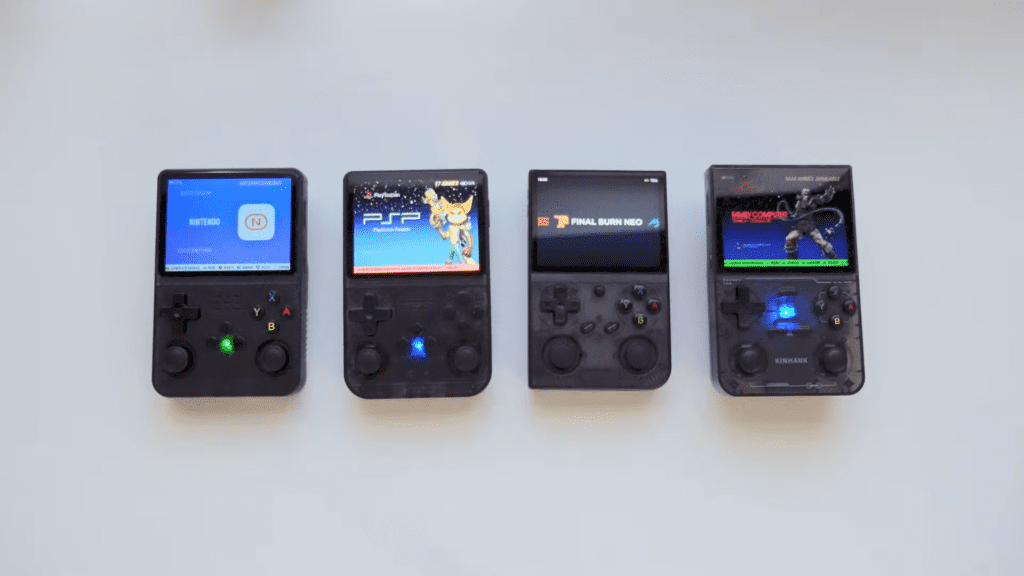
The undisputed winner of this showdown is the BatleXP G350. Rumors suggest this device was covertly engineered by Anbernic to compete in the budget sector, and the build quality supports this theory. It offers superior ergonomics, quiet buttons, better vibration feedback, and seamless compatibility with dArkOS. Given that it sells in the same roughly $20 to $45 price range as the others depending on sales, it offers significantly more hardware for the money. If I were spending my own cash today, the G350 is the only console I would choose, leaving the clones and even the venerable R36S in second place.
