

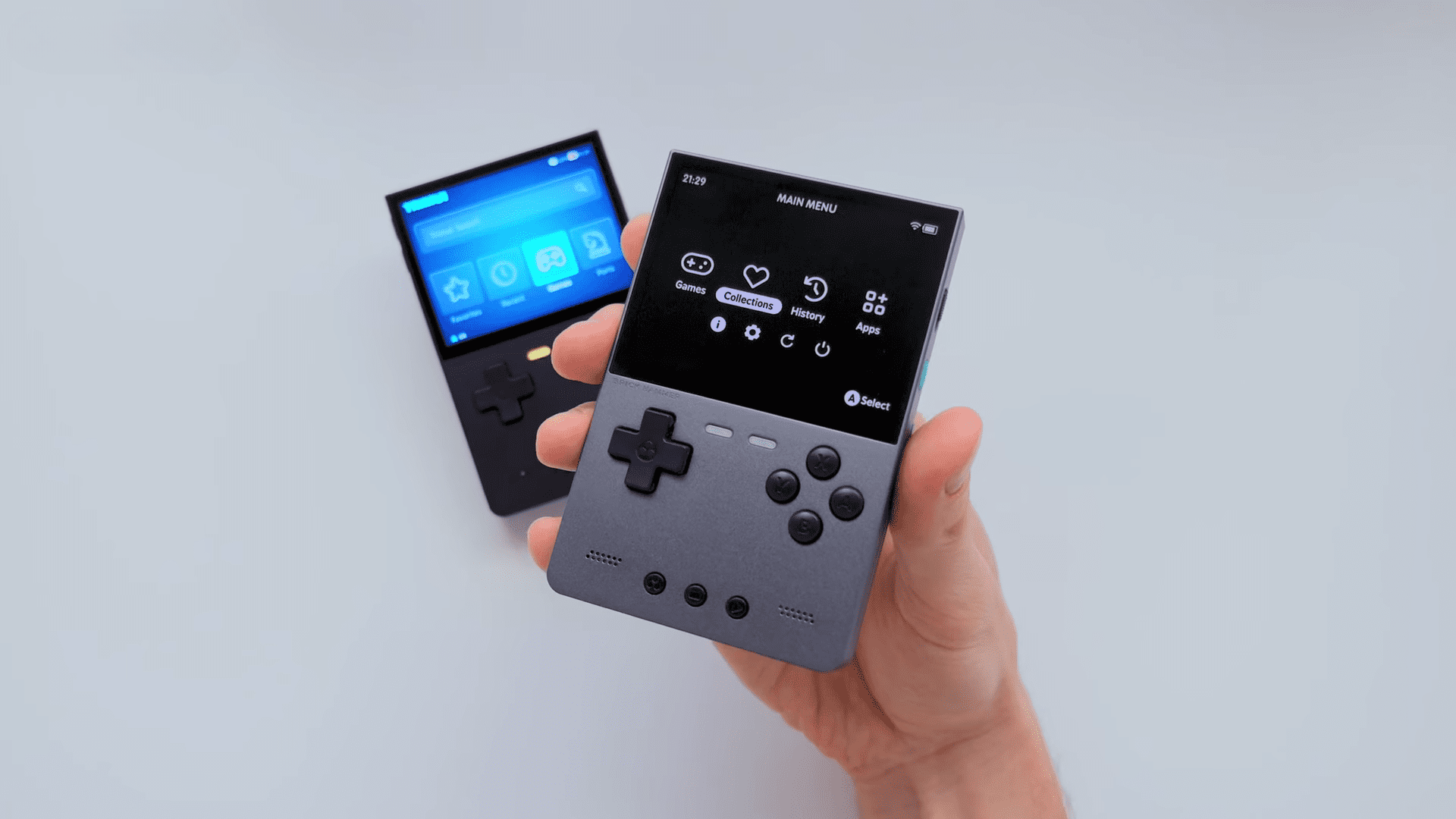
Finding a retro handheld console that genuinely surprises you is a rare occurrence in today’s saturated market. We are constantly bombarded with new devices that promise slightly better specs or a different form factor, yet they often fail to deliver that initial spark of excitement we all chase. It is incredibly uncommon for a console I have loved for a long time to land back in my hands and hit me with the same strong emotions I felt the first time I unboxed it. I experienced that exact feeling of rediscovery with the Trimui Brick Hammer.
The original plastic model has been my daily driver for quite some time, serving as my main retro game console for everyday carry, but the arrival of the metal version—the “Hammer”—has completely shifted my perspective on what this little device can be.
The question of value immediately arises when you see the price tag attached to this premium upgrade. You can currently pick up the Trimui Brick Hammer on AliExpress for around $100, which represents a significant markup over the standard plastic version. That price difference of roughly $30 to $40 might seem steep for what looks, on paper, like the exact same internal hardware.
However, specifications rarely tell the full story. My time testing this unit has convinced me that materials and build quality contribute just as much to the gaming experience as the processor or the screen.

Design & Build Quality
Unboxing the Trimui Brick Hammer reveals a device that is undeniably gorgeous. I opted for the graphite color, which looks sophisticated and sleek, catching the light in a way that plastic simply cannot replicate.
The cold touch of the metal body against your skin is the first indication that you are holding something special. It feels dense, robust, and incredibly solid. There is absolutely no flex or creaking; it is a single, cohesive block of machined perfection. The tactile experience is vastly improved, elevating the device from a casual gaming gadget to something that feels like a piece of industrial art.

The metal version is currently available in several striking colors, including Wild Green, Space Gray, Rose Gold, and the recently added Black and Silver options. Each of these finishes appears to be anodized or coated to a high standard, offering a matte texture that resists fingerprints better than glossy plastic. I found myself admiring the device from different angles, appreciating how the light plays off the chamfered edges and the flat surfaces. It is a device that begs to be held, even when it is turned off.
One unavoidable consequence of switching to a metal chassis is the added weight. I placed both units on a scale to measure the difference precisely. The original plastic Trimui Brick weighs in at 158 grams, while the Brick Hammer tips the scales at 199 grams. That creates a difference of roughly 40 grams. You can certainly feel this extra mass in your hand and in your pocket. For some users, this additional weight might be a drawback, especially for a device designed to be ultra-portable.

However, I found the weight to be a positive attribute rather than a hindrance. During actual gameplay, I barely noticed the heaviness in a negative way. Instead, the added density gives the console a sense of gravitas and stability. It sits more securely in the palms, and the weight balance feels just right. It feels substantial, like a premium smartphone or a high-end watch. The dimensions remain identical to the original, maintaining that pocket-friendly form factor, but the density makes it feel like a much more serious piece of hardware.
Display & Visual Experience
The first ritual with any new handheld is peeling off the screen protector, a moment of pure satisfaction that reveals the pristine glass underneath. The display on the Trimui Brick Hammer is nothing short of stunning. It features a high pixel density that makes retro games look crisp and vibrant. The colors pop beautifully against the deep blacks of the screen, and the viewing angles are excellent. Because the front of the device is now framed by this premium metal shell, the screen almost seems to float within the chassis, creating a more immersive visual experience.

I found the 3:2 aspect ratio of the screen to be particularly versatile for the systems this device emulates best. It provides a great balance for Game Boy Advance titles, filling the screen nicely, while standard 4:3 home console content also looks fantastic with minimal black bars. The brightness levels are more than adequate for indoor use, and I had no trouble viewing the screen in well-lit environments. The glass front panel feels smooth to the touch and adds to the overall rigidity of the device, protecting the panel beneath.
One of the joys of using a high-resolution screen on a retro device is the ability to use shaders and overlays without compromising image clarity. I spent a considerable amount of time tweaking the visual settings for different systems. For the Nintendo Entertainment System and Game Boy Color, I applied shaders that mimic the look of old CRT monitors or the dot matrix grid of the original handhelds. The screen is sharp enough to render these artificial scanlines and pixel grids accurately, making the image look authentic rather than just messy.

The visual experience is further enhanced by the custom firmware I chose to install. I decided to run MuOS on this device, just as I did with my plastic model. The clean, minimalistic interface of MuOS complements the industrial design of the Brick Hammer perfectly. Navigating through the menus feels snappy, and the album art for games looks vibrant on this display. The combination of the metal hardware and the refined software interface creates a cohesive aesthetic that feels modern yet respectful of the retro content it displays.
Performance & Software Experience
Under the hood, the Trimui Brick Hammer houses the exact same internal components as its plastic counterpart. I simply took my microSD card out of the regular Brick and popped it into the Hammer, and it booted up instantly with all my games and settings intact. This seamless transition meant I could jump straight into testing without a lengthy setup process. Running MuOS is, in my opinion, the best way to experience this console. It offers great stability, a user-friendly interface, and the flexibility to customize everything from themes to backend emulator settings.

I ran a gauntlet of games across various systems to verify performance. Starting with the 8-bit and 16-bit eras, the console handles everything flawlessly. Double Dragon on the NES ran perfectly with the shaders applied, delivering smooth scrolling and responsive controls. Disney’s Aladdin on the Sega Mega Drive was fast and fluid, with the vibrant colors of the Genesis palette shining on the display. The d-pad on the Trimui Brick has always been decent, and on the metal version, it feels just as responsive, making platformers a joy to play.
Moving up to handheld systems, The Legend of Zelda: Link’s Awakening DX on Game Boy Color looked incredible. The colors were saturated and rich, and the movement was stutter-free. Game Boy Advance titles like Batman: Rise of Sin Tzu utilized the screen’s aspect ratio well, running at full speed. I also tested Mario Kart DS on the Nintendo DS emulator. The device handled the dual-screen emulation competently, and the 3D graphics were rendered sharply. The performance here is identical to the plastic version, meaning you are paying for the build, not a speed boost.

The real stress test for this chipset comes with PlayStation and PlayStation Portable (PSP) titles. Earthworm Jim 2 on PS1 ran without a hitch, maintaining a solid framerate even during chaotic moments. PSP emulation is where you begin to see the limits of the hardware, regardless of the shell material.
I tested Grand Theft Auto: Vice City Stories, a notoriously difficult game to emulate. The experience was surprisingly playable with almost no noticeable lag or stuttering in the sections I played. However, the small screen size makes PSP games less than ideal for long-term play, even if the performance is technically sufficient.

Metal Slug XX on PSP also ran smoothly, proving that 2D titles on the more advanced handheld system are well within the Brick’s capabilities. Additionally, thanks to MuOS, the device supports PortMaster, which opens up a library of PC ports. I played Celeste via PortMaster, and it was a highlight of my testing. The game requires precise timing, and the Brick Hammer delivered a lag-free experience that felt native to the hardware. The metal buttons provided a satisfying click that enhanced the platforming precision.
Battery & Charging
Battery life on the Trimui Brick Hammer remains consistent with the plastic version, as the internal battery capacity has not changed. The device is generally efficient enough for several hours of gameplay, depending on the system you are emulatingCharging is handled via the USB-C port, and the device tops up relatively quickly.
I did not experience any significant heat buildup during my testing, which is a common concern with metal handhelds. Metal conducts heat better than plastic, meaning the device can sometimes become uncomfortably warm if the processor runs hot. Fortunately, the chipset in the Trimui Brick is not a powerhouse that generates excessive heat.

Final Thoughts
We must address the elephant in the room: the price premium. Paying roughly $75 for the metal version versus significantly less for the plastic one is a decision that depends entirely on what you value as a gamer. If you are strictly looking for the best price-to-performance ratio, the plastic Trimui Brick plays the exact same games at the exact same speed for less money. From a purely utilitarian standpoint, the plastic model is the logical choice for budget-conscious buyers.
However, the market for retro handhelds is driven by nostalgia and the joy of collection. For enthusiasts who view these devices as more than just emulators, the Brick Hammer offers incredible value. The build quality rivals devices that cost twice as much. The improved audio alone is a significant functional upgrade, and the tactile satisfaction of the metal shell fundamentally changes how the device feels to use. It transforms the Trimui Brick from a budget recommendation into a premium staple of a collection.

I believe the extra $30 or $40 is absolutely worth it for the improved tactile feel and sound. When you factor in promotional codes and sales often available on AliExpress, the price becomes even more attractive. It sits in a unique position in the market—more premium than the budget plastic handhelds, yet more compact and focused than the expensive Android-based metal handhelds. It occupies a niche for vertical metal handhelds that is surprisingly under-served at this specific size and price point.
