

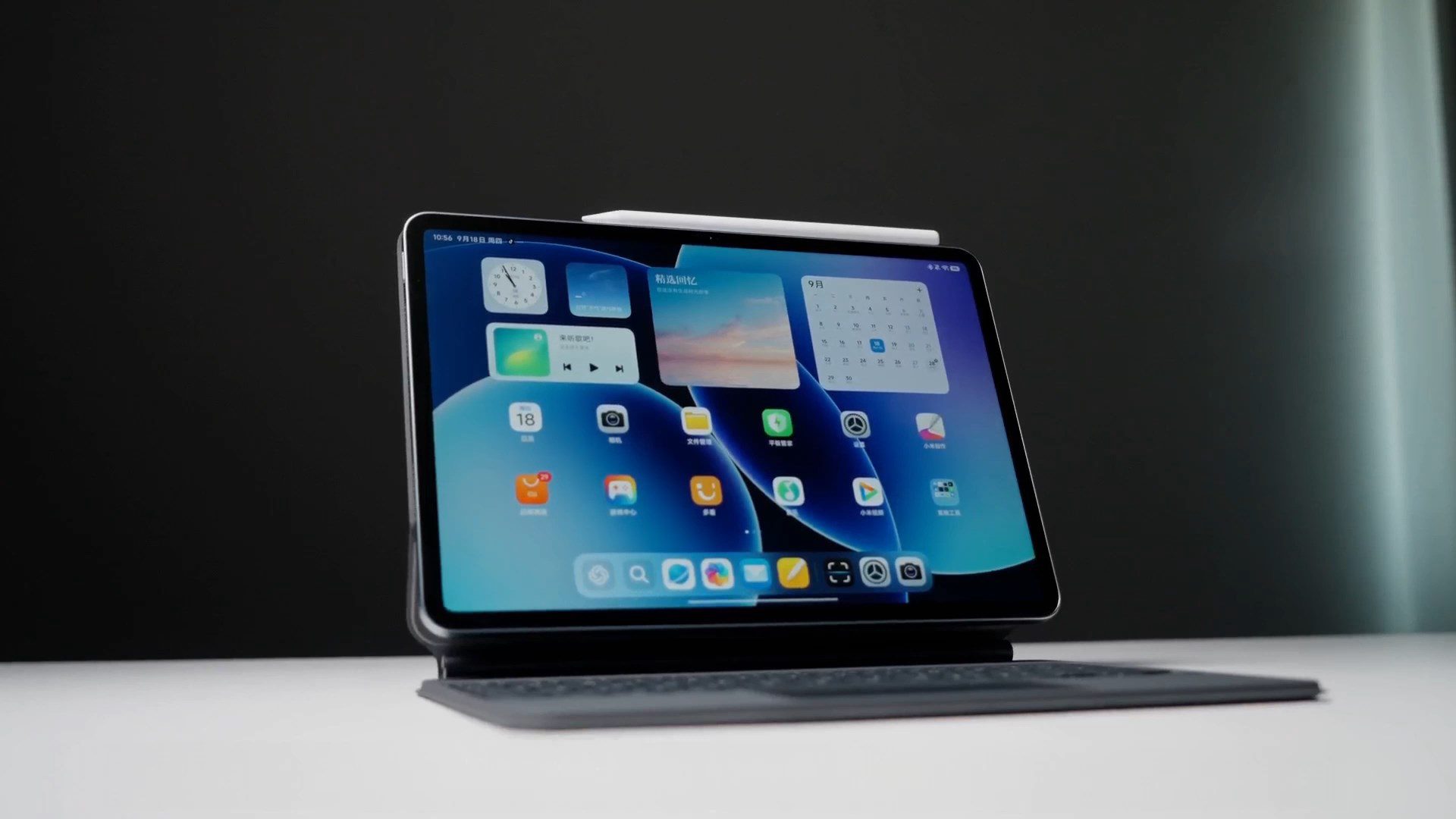
New Xiaomi tablet products have been arriving one after another this year. After releasing two mid-range OLED tablets with self-developed chips, Xiaomi has finally unveiled the Xiaomi Pad 8 Pro, which features a flagship Snapdragon chip. Today, we’ll experience this comprehensive upgrade in hardware, software, and accessories together.
Design
Taking a brief look at the exterior design, the back remains a simple square camera module. The unit we have is a color somewhere between silver and light blue. As an 11-inch tablet, compact and portable is its primary mission, so the Xiaomi Pad 8 Pro has a body thickness of only 5.75mm and a weight of 480g. It fits easily into a standard messenger bag without feeling like a burden, and holding it with two hands or two fingers doesn’t create too much pressure.

Display & Screen Technology
Coming to the front, this is an 11.2-inch, 3.2K resolution, 144Hz high-refresh-rate LCD screen. Users of the Pad 7 series will not be unfamiliar with this screen; it features 800 nits of brightness and supports Dolby Vision video playback.
You may have noticed this is a “soft-light” screen that doesn’t reflect much light. That’s right, this is the biggest upgrade for the Xiaomi Pad 8 series in terms of display: for just an additional ≈ $30 USD, the entire Xiaomi Pad 8 series can be configured with this nano-texture soft-light screen. Its advantage is that you can see the difference simply by placing it next to a standard glossy screen; it eliminates 99% of interfering light and lowers screen reflectivity by 70%, making it much more suitable for use in environments with complex lighting.

It’s worth noting that there are differences between various soft-light screens. Usually, matte screens or “paper-like” screen protectors give an impression of screen graininess and excessive grain, but Xiaomi’s AG etching technology reduces sparkles by 44%, making the picture finer and the viewing experience softer.
Accessories
On the hardware front, the Xiaomi Pad 8 Pro is also equipped with brand-new productivity accessories. First is this floating keyboard, which fills the gap in texture. This time, the entire Xiaomi Pad 8 series can select this option. It connects via magnetic pins for latency-free sensing, and once attached, it supports stepless adjustment from 1 to 124 degrees. Whether adjusting the screen angle or the overall opening and closing resistance, it feels very tight. Restricted by the 11-inch body size, it isn’t a full-sized keyboard, and the key spacing and touchpad area are compact, but fortunately, the typing rebound feel is crisp and sharp, and it also supports backlighting.

Next is this brand-new Xiaomi Focus Stylus Pro. In terms of grip, it adopts a unibody design with no physical buttons on the pen body, weighing only 17g, making it comfortable to hold. For writing, the nib is softer, providing more obvious rebound and stronger writing friction. The 16,384 levels of pressure sensitivity are a doubled improvement compared to the previous generation, so the line thickness is more controllable. The tracking and note-taking drift issues have also been optimized due to sensor upgrades, with ultra-low latency across all scenarios.
The new gesture interactions are also a major upgrade for the Xiaomi Focus Stylus Pro. In the canvas app, a light squeeze brings up the palette; double-tapping the pen body allows you to adjust brush parameters; and sliding adjusts brush thickness. These operations all include vibration motor feedback, providing subtle interaction.

Performance & Gaming
Moving on to the chips inside, the Xiaomi Pad 8 Pro finally returns to a true flagship chip: the Snapdragon 8 Elite. Performance is not a concern. As usual, we conducted a game test at 25 degrees Celsius room temperature with 200 nits screen brightness.
In “Genshin Impact,” running smoothly in the wild, it achieved an average of 59.8 frames per second with an average power consumption of 5.8W, consuming 9% power. In the “Honkai: Star Rail” Golden Hour test, it also produced a result of 59.6 frames per second with an average power consumption of 7.1W, also consuming 9% power. Thanks to the top-tier chip and the tablet’s large heat dissipation area.

The Xiaomi Pad 8 Pro also supports natively running PC games. Currently, it only optimizes “Naraka: Bladepoint” and “Hollow Knight.” After downloading via Steam, transferring via the Xiaomi WinPlay engine allows you to play locally.
Battery & Charging
To discuss performance, we can’t ignore fast charging and battery life. The Xiaomi Pad 8 Pro is equipped with a 9,200mAh battery. In our four-hour heavy gaming battery life test, it had 52% power remaining, which is very robust. In comparison, the 67W wired charging is quite satisfactory; practically tested, it charges to 54% in 30 minutes and 100% in 71 minutes.

System & Software
Finally, let’s talk about the system. The new HyperOS 3 offers a distinct experience on the large screen. In terms of animation, the Xiaomi Pad 8 Pro also utilizes window rendering sinking technology. Simply put, usually when we open an app, there are many rendering tasks proceeding simultaneously. This task migrates the rendering task of window animation from the application layer, which competes for resources with other tasks, to the system layer with higher priority, making the experience of opening apps smoother.
Since there is a large 11.2-inch screen, multi-window use is bound to be a heavy usage scenario. Therefore, in terms of performance scheduling, the Xiaomi Pad 8 Pro’s multi-window focus scheduling technology can intelligently identify application windows that are obscured or hung in small windows, reducing their resolution and frame rate while tilting resources toward the foreground window to improve overall fluidity and lower global power consumption.

With this PC mode, the dock bar can display up to 10 current applications and 13 commonly used applications. We can also perform “open application” default landscape window state optimization on commonly used apps, which feels a bit like a small laptop.
Conclusion
Comparing the previous generation, whether it is the performance boost brought by the top-tier flagship chip or the productivity boost brought by the flagship-level peripherals, the Xiaomi Pad 8 Pro ≈ $392 USD, has the ability to challenge “Ultra-level” tablets. The debut of HyperOS 3 provides a smoother and more practical performance for its daily experience.
