

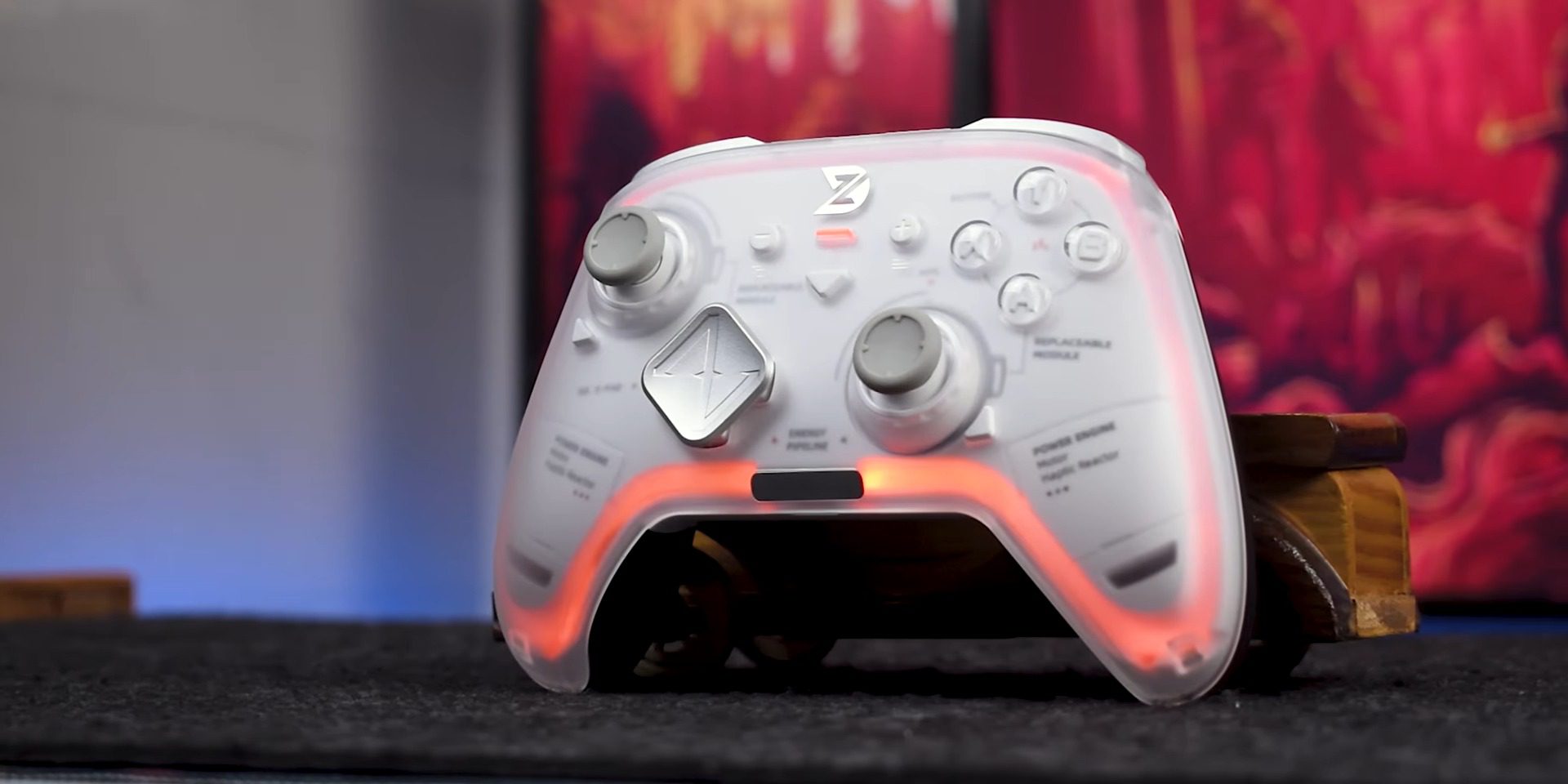
The ZD Ultimate Legend has arrived on my desk as a multi-platform controller that promises an insane level of customization. It packs specifications that make standard options look outdated, including six vibration motors and a staggering 4000Hz polling rate.
For a price of around $99.99 on Amazon and AliExpress, the package offers a surprising amount of hardware. You are getting TMR joysticks, which are becoming the new standard, alongside the ability to hot-swap between four different sensor types. It sits in a competitive bracket, yet the spec sheet suggests it might be punching well above its weight class.
I have been testing this controller extensively to see if the real-world performance matches the marketing hype. High polling rates and fancy modular parts are great on paper, but they need to translate into actual gameplay advantages. My testing involved everything from fighting games to racing simulators to determine if this “Ultimate Legend” lives up to its name.

Unboxing and Modular Accessories
Opening the box reveals the controller sitting right at the top, accompanied by a user guide and a high-quality braided USB-C cable. You also get a 2.4GHz wireless dongle and two additional thumbsticks that are easy to attach. The package goes deeper with extra buttons specifically for swapping to a Switch layout and four distinct D-pad options.
Among the included D-pads, the hybrid and plus-shaped versions stood out during my testing as the most effective. ZD Gaming also offers an optional charging dock that serves as more than just a stand. It features two USB 3.0 pass-through ports, a Type-C charging port, and a built-in storage slot for the wireless dongle.
Build Quality, Design, and Ergonomics
The plastic quality immediately impressed me with its precision. There are no gaps, sharp edges, or creaking sounds when handling the device. The default faceplate sports a frosted translucent finish that resists fingerprints effectively, which is a massive win for keeping the setup looking clean.
Grips feature a rubberized textured surface that feels premium in the hand. This texture provides a softer, more comfortable hold compared to standard plastic, making a significant difference during long sessions. The ergonomics are spot on, fitting perfectly in the hand to prevent fatigue even after hours of play.

Weighing in at approximately 300 grams, the ZD Ultimate Legend feels substantial without being heavy. It is an incredibly well-balanced controller. I found no rattling or wobbling in the triggers or sticks, making the unit feel tight, solid, and well-assembled.
Buttons and Input Layout
Under the glossy face buttons, you will find Kailh Purple Gold microswitches. These provide direct contact without a rubber membrane, resulting in a tactile and responsive click. While they feel different from traditional membrane buttons initially, they quickly became my favorite due to how easy they are to press.

The face buttons follow the curvature of the controller’s shell, adding a premium aesthetic. Because of this unique curve and varying thickness, you cannot simply swap in generic buttons; you must use the specific ones provided in the box for layout changes. They do have a slight side wobble, but it does not impact gameplay.
The D-pad utilizes the same microswitch technology, making it easy to reach and press. It offers tactile feedback similar to other high-end controllers like the GameSir G7 Pro. I found the diagonals to be precise, ensuring no missed inputs during fighting games, and sliding across all eight directions feels smooth.

Hot-Swappable Joysticks and TMR Technology
This controller features high-resolution TMR joysticks, which are an upgrade over standard Hall Effect sensors. They offer better precision and lower power draw. The sticks use metal stems and anti-friction rings, creating an incredibly smooth glide that feels soft yet responsive.
A standout feature is the ability to hot-swap the joystick modules entirely. You can install options like the JS13 Pro Hall Effect, Taiwanese Carbon membrane potentiometers for stiffness, or standard ALPS potentiometers. The default RJ13 TMR sticks are accurate, but the option to change the physical mechanism is revolutionary.

Calibrating these sticks is necessary after swapping. The process involves holding specific button combinations until the LEDs change color, rotating the sticks, and saving the profile. Once calibrated, circularity tests show minimal error rates and absolutely no stick drift.
Performance, Polling Rate, and Latency
Performance on a wired connection is top-tier, boasting a 4000Hz polling rate. This results in extremely low latency, giving a significant competitive edge in FPS titles. The stability and speed over the wire are impressive and exceed advertised specs in some tests.

Switching to wireless modes does reduce this speed. The 2.4GHz dongle connection drops the polling rate to around 900Hz, while Bluetooth sits at roughly 250Hz. For casual gaming, wireless is fine, but for competitive play, the wired connection is where this controller truly shines.
The 1500mAh battery supports these features well, lasting between 10 to 15 hours depending on your usage. Heavy use of the RGB neon strip and haptics will naturally drain it faster, but the battery life is solid for a controller with this much tech inside.

Haptic Feedback and Trigger Implementation
The Hall Effect analog triggers come equipped with trigger locks and microswitches for a crisp feel. However, the real upgrade is the rumble motors located inside the triggers themselves. This takes immersion to a new level compared to standard controllers.
Playing racing games like Forza demonstrates this perfectly. As you press the brake, the feedback starts light and ramps up instantly the further you press. By the time you hit full depression, the haptics are maxed out, providing detailed information about the car’s behavior.

Grip haptics are also more immersive than what is usually found in this price bracket. The bumpers feel solid with a consistent profile across the board, featuring the same textured surface as the triggers.
Programmable Buttons and Software Features
Two unique “claw buttons” sit at the top of the controller, alongside four back buttons. All of these use microswitches and are placed in ergonomic positions that are easy to reach. They are fully programmable, allowing for extensive customization of your control scheme.

Setting up macros and turbo functions is straightforward and can be done directly on the device. You can map complex combos or set buttons to auto-fire without needing deep software diving. The instructions for mapping the claw and back buttons are simple to follow using the mode button.
An RGB neon strip on the front adds a visual flair. While I wish it were slightly brighter, it looks good and can be customized via the dedicated app. The app also allows for further fine-tuning of the controller’s settings.

Final Thoughts — Price & Value
The ZD Ultimate Legend retails for approximately $99.99 on Amazon and AliExpress. While the optional charging dock adds about $22, and extra joystick modules cost around $12, the base package delivers an immense amount of technology for the price. ZD Gaming backs this up with a 12-month warranty, adding a layer of security to the purchase.
The feature set here surpasses the Xbox Elite Series 2 and many other pro controllers on the market. With its 4000Hz polling rate, modular joysticks, and trigger rumble, it makes a strong case for being the best pro controller of 2025 for PC users. It offers a level of customization that usually costs significantly more.
For those on a tighter budget, something like the EasySMX X05 might be a better fit. However, for enthusiasts willing to spend around $100, the ZD Ultimate Legend provides a premium, high-performance experience that is genuinely hard to beat.
