

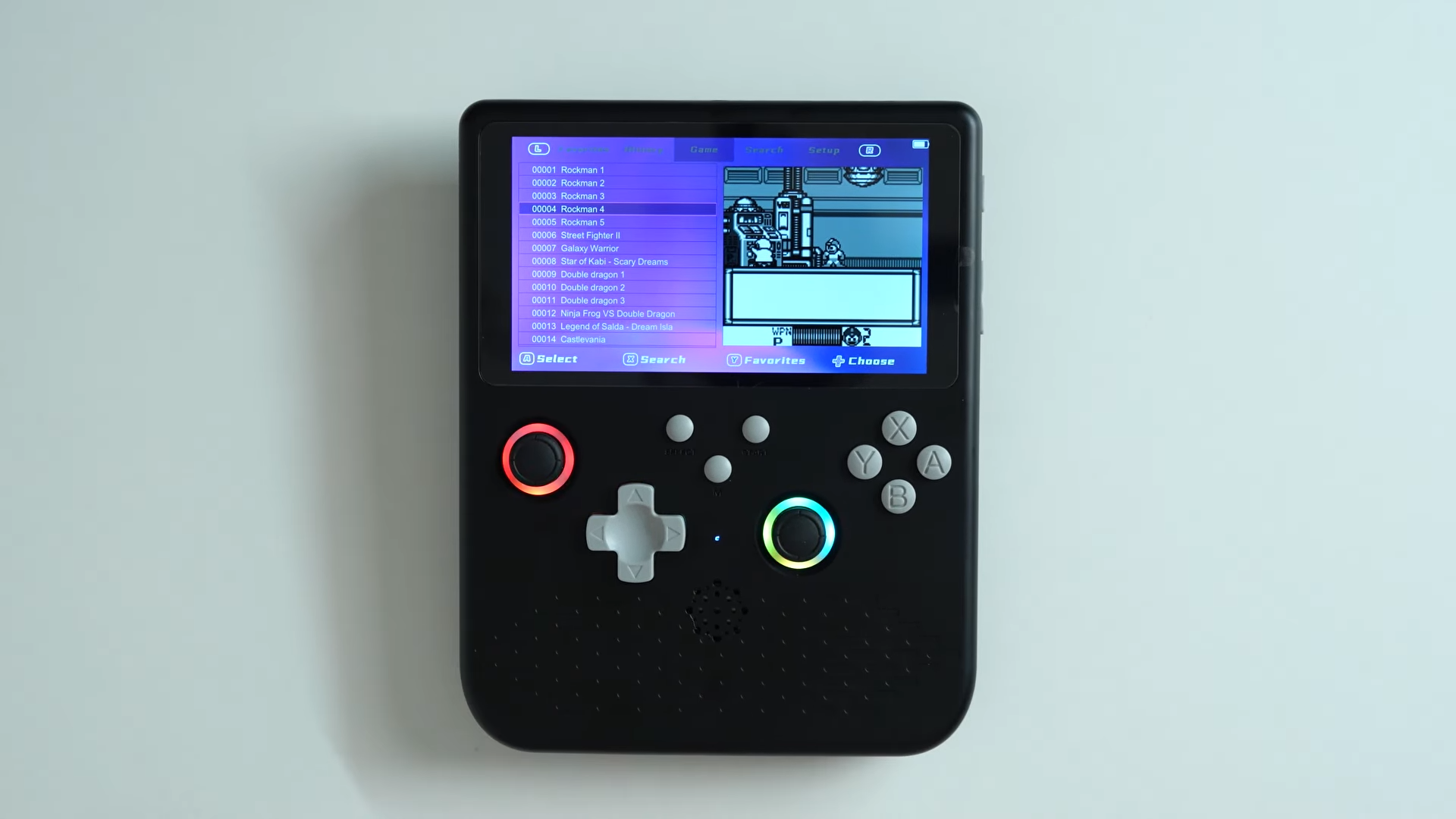
The market for retro gaming handhelds is more crowded than ever, forcing manufacturers to compete on screen size and price. I recently purchased the H5 Game Console from AliExpress for approximately $59.98. This device immediately stands out due to its claim of offering a large five-inch display for such a low price.
Many budget-conscious gamers struggle with tiny three-inch displays that strain the eyes during long play sessions. This unit aims to solve that problem by providing a spacious screen without exceeding the budget of casual hobbyists.

Design and Unboxing Experience
The unboxing experience is remarkably plain, featuring a generic cardboard box labeled only with the “H5” name. Inside, the packaging contains the console, a USB-C charging cable, and a basic instruction manual. Buyers will also receive a pre-installed 64GB MicroSD card, even though there was no option to select storage size during checkout.

Placing the device next to a popular handheld like the R36S reveals an enormous size difference. The physical footprint is surprisingly massive, making it feel more like a mini-tablet than a portable gaming device. This large scale provides a solid feel, but it definitely compromises pocketability for daily travel.
The exterior shell features a matte finish that attempts to mimic premium textures. Holding the device for extended periods reveals that the plastic feels somewhat cheap, reflecting the ultra-low manufacturing budget. The black color option provides a clean look, though the housing easily attracts fingerprints.

Controls and Port Layout
The front control layout includes asymmetric analog sticks, select and start buttons, and a central function button. These analog sticks do not feature L3 or R3 click inputs, suggesting that the manufacturer utilized low-cost joystick components. The D-pad uses a single-pivot design where pressing one edge causes the entire pad to shift down.

Despite my personal dislike for this style of mushy D-pad, performing fighting game commands feels surprisingly responsive. The right side of the device houses a mono speaker, a reset switch, the power button, volume keys, and the MicroSD card slot. The top edge provides access to a 3.5mm headphone jack, an OTG port, and a USB-C charging port.
Looking at the back of the device, you will find basic shoulder buttons labeled L1, R1, L2, and R2. The rear grips look like rubber pads in promotional pictures, but they are actually molded from standard hard plastic. This lack of soft materials means the ergonomics do not offer any real comfort during longer sessions.

Display Performance
The primary selling point of the H5 is the large five-inch IPS display with a resolution of 1280×720. Most budget retro handhelds in this price bracket stick to lower-quality 640×480 panels. This step up in resolution makes text and 2D sprites look incredibly clean and highly legible.

IPS panel technology ensures that the viewing angles remain consistent even when tilting the console. Color reproduction leans toward a warmer, slightly muted tone that mimics an old-school CRT monitor filter. Gamers wanting vibrant, modern color palettes might find this screen a bit dull.
Integrated RGB lighting surrounds the bases of both analog sticks, activating as soon as the system boots. The system settings menu allows users to disable this lighting to save battery power. There are no options to customize the color cycle, leaving users with a fixed rainbow effect.

Hardware Limitations and Emulation Capabilities
Powering this device is an RK350 Cortex-A7 processor, which relies on a very modest hardware architecture. Rising memory prices in the tech industry have clearly forced the manufacturer to compromise on RAM capacity. This low RAM limit means that emulation is strictly confined to older retro systems.

Running 16-bit classics from the Game Boy Advance, Sega Mega Drive, and Super Famicom works flawlessly. Games on these systems maintain stable frame rates with clear audio output. Attempting to emulate PC Engine games yields inconsistent results, with many titles running far too slowly.
PlayStation 1 emulation represents the absolute performance ceiling for this specific hardware configuration. Most PS1 games run at playable speeds, which is impressive given the low price of the handheld. Do not expect to run any systems beyond the PS1 era on this chipset.

Navigating the Custom Linux OS and Game Library
This console utilizes a custom Linux-based operating system rather than the standard EmulationStation software. The menu interface is straightforward, offering basic brightness adjustments and language support for Korean. The included storage comes pre-loaded with a massive collection of 15,247 games.

Navigating this library reveals that a vast majority of the files are Chinese language ROMs. The emulators are categorized into folders representing classic systems like Capcom Play System, NeoGeo, and Famicom. Some folders contain mismatched games, meaning you might find Game Boy Color files inside the GBA directory.
Adding your own games is extremely difficult because the storage card uses a complex Linux partition. Windows computers will not recognize these partitions natively, preventing easy drag-and-drop file transfers. Casual users who lack technical knowledge should assume they cannot add new games to this device.

Battery Endurance and Screen Aspect Ratio
The large physical footprint of the chassis accommodates a generous 4,000mAh battery. Because the internal processor has very low power demands, this battery easily delivers over six hours of continuous use. This long battery life makes it an appealing choice for long travel days.

Carrying this bulky device around in a standard pocket is highly impractical due to its sheer size. The widescreen 16:9 ratio is also slightly awkward for older 4:3 titles, leaving black bars on the sides. Game Boy Advance games utilize the screen real estate much better due to their wider native aspect ratio.
The operating software includes a scaling option to stretch retro games to fill the entire screen. Stretching 4:3 games compromises the visual integrity, so sticking to the original aspect ratio is highly recommended. The system also includes three pre-installed UI themes to slightly customize the menu appearance.

Final Thoughts — Price & Value
The H5 Game Console offers a unique value proposition by providing a massive screen on a strict budget. Combining a sharp 720p display with a long-lasting 4,000mAh battery creates a decent platform for playing older 16-bit games. The bulky physical design and stiff button inputs prevent it from being a truly comfortable handheld.
Paying the full retail price of $59.98 feels like a stretch for this level of quality. Retro gaming enthusiasts should skip this model entirely to avoid the frustrating Linux file system and performance limitations.
