

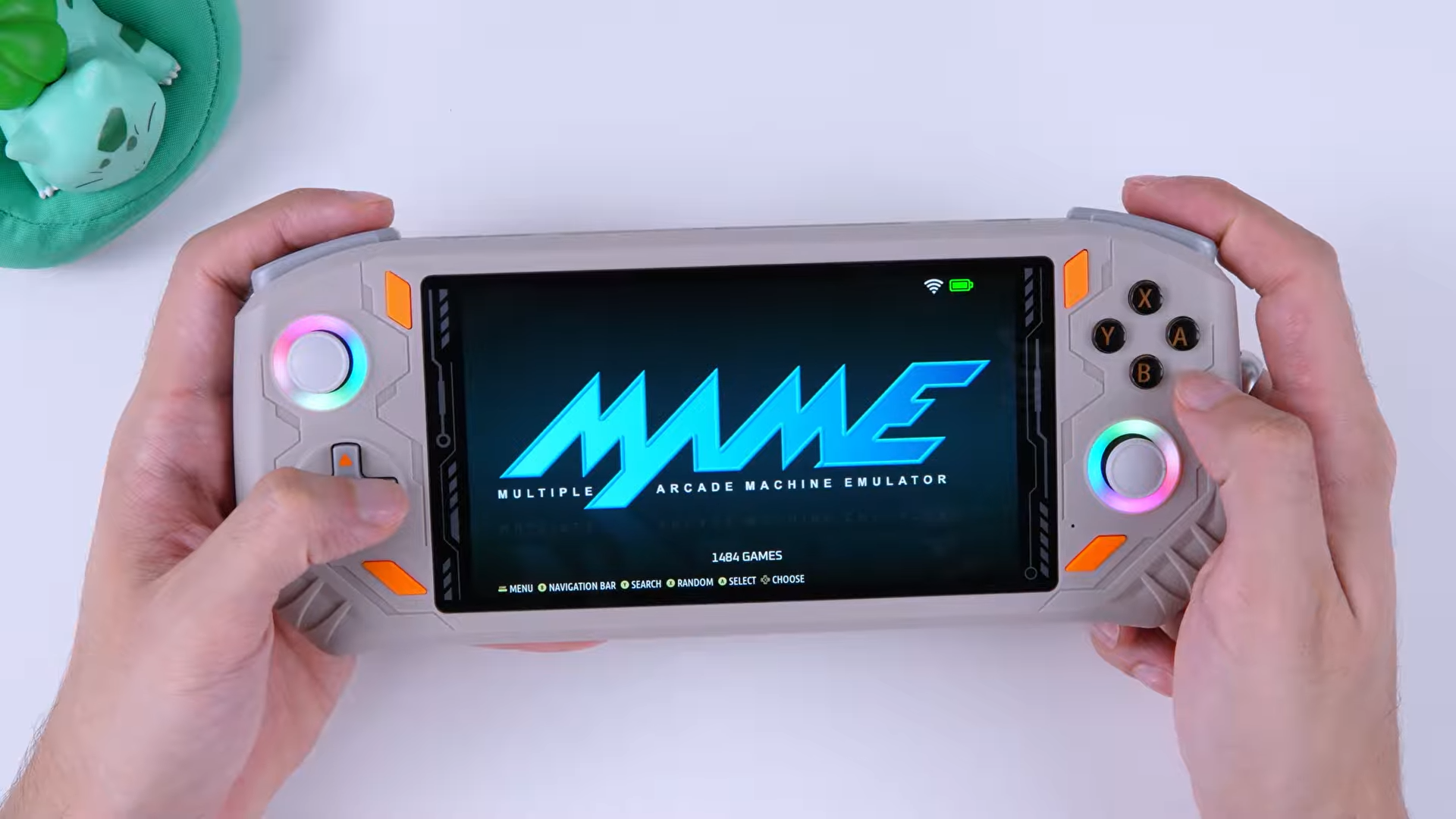
The budget handheld market welcomes a highly intriguing contender in the form of the RG52 Mini. I spent extensive time analyzing this entry-level console to determine how well it handles retro emulation and daily physical wear. Packaged in a minimalist blue box, this device immediately stands out due to its compact form factor and surprising hardware choices. My evaluation focuses on its daily usability, software performance, and the unique features that set it apart from other budget options.
Securing this console usually requires a budget of $60 to $75 on online marketplaces like AliExpress, making it an accessible option for newcomers. My hands-on testing with the system reveals that it punches well above its price tag despite minor shortcomings.

Unboxing and Physical Build Quality
Unboxing the package reveals a selection of basic accessories alongside the console. Inside the box, I found a short USB Type-C charging cable, a screen protector, cleaning wipes, and an instruction manual detailing important system shortcuts. The console is available in black, grey, and green color schemes. My review unit came in the grey colorway, which features striking orange accents around the buttons and analog sticks, giving it a playful retro aesthetic.

The physical layout of the console remains mostly traditional but introduces some unique visual flair. The front face features semi-transparent buttons backed by vibrant RGB lighting around the joysticks, which adds a premium feel to this budget device. I noticed that the Start and Select buttons are positioned at the very bottom of the faceplate rather than the top, which might feel slightly unintuitive during fast-paced sessions. The top edge houses the analog triggers, volume buttons, a micro-HDMI output port, a reset button, and the power switch.
Handling the back of the device reveals some thoughtful ergonomic choices and an interesting design choice. A textured, grippy surface occupies the rear shell to prevent slipping during intense gameplay. There is also a distinct grille that looks like an active cooling fan, but my inspection confirmed it is actually a passive heat dissipation vent. The bottom edge houses the dual stereo speakers, a 3.5mm headphone jack, a USB Type-C charging port, and a microSD card slot that supports cards up to 1TB in size.

Hardware Specifications and Display Quality
Under the hood, the console relies on a capable entry-level silicon setup. It is powered by a Rockchip RK3562 processor paired with 2GB of RAM and 8GB of internal storage. Visuals are handled by a 5.5-inch IPS display sporting a crisp 1280×720 resolution. This screen is a major highlight of the device, delivering highly vibrant colors and wide viewing angles that elevate the visual quality of classic retro games.

Powering the system is a generous 5000 mAh battery designed to last up to eight hours on a single charge. Actual battery life depends heavily on screen brightness levels and the demands of the emulator you are running. Navigating back to the main interface is incredibly easy thanks to a dedicated “back” button on the front of the unit. This button eliminates the need for complex hotkey combinations, letting you exit games instantly with a single press.
Wireless connectivity consists of 2.4GHz Wi-Fi, which is essential for updating the operating system and downloading game assets. A major hardware limitation to keep in mind is the complete absence of built-in Bluetooth connectivity. Connecting external controllers to the console requires using a physical USB hub. The operating system is built on a streamlined Linux platform, providing a lightweight environment that maximizes the performance of the entry-level processor.

System Interface and the Built-In Download Server
The device comes bundled with a 64GB microSD card containing approximately 5,000 pre-installed games. The default Linux menu organizes games by console emulators, though the library presentation feels slightly unpolished because many titles lack original box art. Within the system settings, you can adjust screen brightness, customize or completely disable the joystick RGB lighting, run battery health tests, and map external controllers. Running games is impressively fast, with most titles booting up in just a few seconds.

Accessing the alternative menu reveals the most unique software feature of this handheld. Holding down the power button and selecting the third option boots the device into a secondary system interface. Using this system requires an active Wi-Fi connection to access its built-in downloader application. This specialized app connects directly to a remote server hosted by the manufacturer, hosting a massive library of downloadable retro titles across various classic platforms.
Navigating this download manager reveals exactly how many games are available for each emulator. Selecting a game like Mega Man Battle Network 3 or Mario & Luigi on Game Boy Advance starts an automatic download process. The system downloads, installs, and fully configures the game files without requiring any manual file transfers or complex directory setup. This seamless integration makes the console incredibly user-friendly for players who prefer to avoid managing ROM files on a computer.

Emulation Performance and Controller Accuracy
Retro emulation on this device is highly satisfying when focusing on classic platforms. Classic consoles up to the original PlayStation run flawlessly, maintaining smooth frame rates and accurate sound reproduction. Dreamcast emulation also performs surprisingly well, allowing users to play through most of the console’s library with decent stability. However, pushing the hardware beyond these systems reveals the clear boundaries of the Rockchip processor.

Resource-heavy platforms like the PlayStation Portable (PSP) and Nintendo 64 highlight the console’s hardware limits. Running highly demanding titles such as God of War results in severe frame drops and sluggish performance, even after modifying emulator settings. Lighter PSP titles run perfectly fine, but you should expect performance issues on more complex 3D titles. Classic retro platforms remain the primary sweet spot for this hardware configuration.
Input accuracy is a mixed bag depending on your preferred playstyle. The analog joysticks are highly responsive and precise, allowing for smooth execution of complex special moves in fighting games. The d-pad, however, struggles to register diagonal inputs reliably, which can be frustrating during precise platforming or fighting games. Testing games like Metal Slug shows that holding down-forward or down-backward inputs often fails to register, meaning this d-pad is not ideal for competitive fighting games.

Thermal Management and Real-World Comfort
Extended gaming sessions demand good heat management to prevent physical discomfort. I utilized a precise thermal imaging gun to measure the external temperature of the console under heavy emulation load. The passive cooling architecture succeeds at keeping the internal components cool without the noise of a mechanical fan. Air flows naturally through the rear ventilation grille to prevent the internal processor from throttling.
Thermal testing showed that temperatures peaked around 43°C on the left side of the casing, which is where the Rockchip processor is located. This heat stays concentrated within that specific area and does not spread across the grips. The plastic shell does not feel hot to the touch during play, ensuring that hands remain cool and comfortable. Excellent weight distribution and ergonomic grips make it easy to hold the 310-gram console for several hours without fatigue.

Final Thoughts — Price & Value
The RG52 Mini establishes itself as a highly competitive option in the modern budget handheld market. Retailing between $60 and $75, this console delivers an impressive balance of build quality, vibrant IPS display performance, and ergonomic comfort. Standard budget devices from competing brands have steadily climbed toward the $80 to $90 range, which positions this specific unit as a highly attractive alternative for bargain hunters. Accessing my Telegram channel can also help secure additional discounts to bring the purchase price down even further.

Minor drawbacks like the lack of Bluetooth connectivity and the average d-pad diagonal inputs do require some compromise. However, the inclusion of a robust dual-system interface, a massive pre-loaded game library, and an incredibly convenient direct download feature outweighs these physical limitations. Buyers seeking a reliable, inexpensive entry point into retro emulation will find immense value in this compact package. I highly recommend considering this handheld if you want a robust, travel-friendly gaming companion without breaking the bank.

1 Comment
Vim pelo chat gpt,Essa é a melhor avaliação da internet, obrigado por solucionar minhas dúvidas. Não sabia da interface adicional, e já desconfiava que não tem bluetooth.