

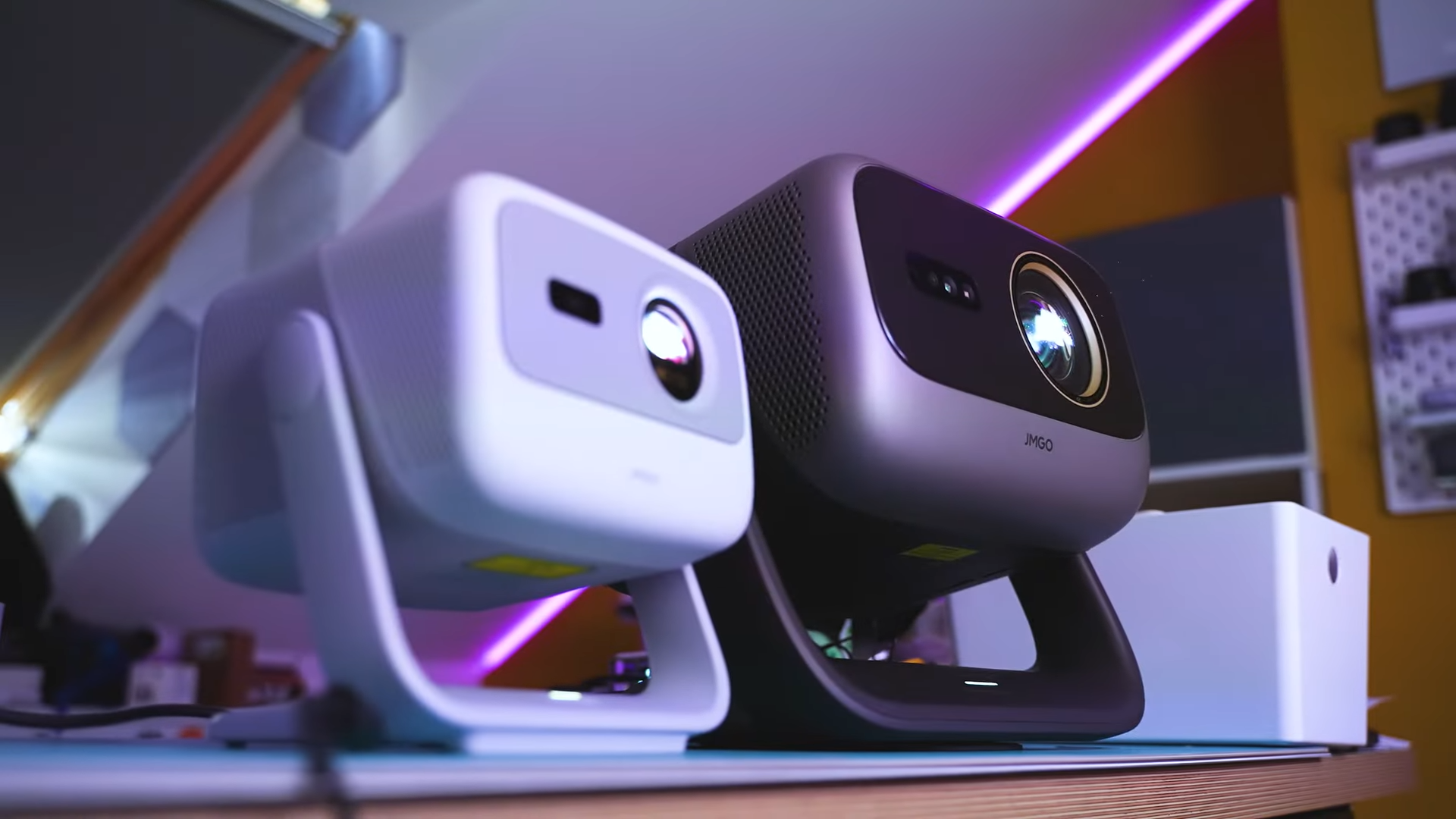
The modern 4K projector market is filled with confusing marketing jargon, varying price points, and conflicting specifications. My goal is to break down these complexities by comparing two distinct units from JMGO: the budget-friendly N1S and the premium flagship N3 Ultimate.
Pricing on platforms like Amazon reflects this clear divide, positioning one as an accessible entry point and the other as a high-end investment. I have spent extensive time testing both systems to understand how they perform in real-world scenarios.
Understanding projector technology does not require a degree in engineering, but knowing key terms like lens shift and DMD chips is essential. This analysis will cut through the noise to show exactly what you get when stepping up from a standard model to a luxury setup. Football matches, backyard movies, and cinematic living room sessions all demand different strengths from a projection system. My evaluation focuses strictly on physical testing and practical utility.

Portability and Physical Footprint Differences
Physical dimensions dictate how a projector fits into your daily routine. The JMGO N1S offers a remarkably compact and lightweight design that facilitates effortless movement between rooms. This smaller form factor allows for quick backyard movie nights and makes storage simple when the device is not in use. Heavy, bulky units cannot match this level of spontaneous flexibility.

Mounting options represent another critical area where physical design impacts usability. The N1S features a standard 1/4-inch mounting thread, which ensures compatibility with a vast array of affordable third-party tripods and ceiling mounts. Selecting this model simplifies installation and keeps mounting accessory costs to a minimum. Users looking to integrate their projector into a temporary or highly mobile setup will benefit from this design.

The JMGO N3 Ultimate takes a completely opposite approach, prioritizing internal technology over compact size. This flagship model houses larger optics, an advanced cooling array, and substantial speaker chambers, resulting in a much heavier footprint. Stationary living room configurations are the primary home for this unit, and using the manufacturer’s dedicated stand system is highly recommended. Portability is sacrificed here to make room for uncompromising hardware performance.

Brightness and Energy Consumption
Brightness stands as a cornerstone specification that directly dictates daytime usability, maximum screen size, and HDR impact. The JMGO N1S punches well above its weight class, delivering impressive illumination levels that challenge much pricier competitors. Operating this budget-friendly model at a comfort level of seven out of ten provides a highly satisfying image in most darkened rooms. It represents an efficient use of LED technology for standard indoor environments.

The N3 Ultimate provides massive brightness reserves, allowing it to perform comfortably at settings as low as three or four out of ten. High ambient light environments or massive screen projections require this type of visual power to maintain color saturation. Having these reserves ensures that daytime viewing remains crisp and clear without washing out the picture. This added power transforms the viewing experience in brightly lit living spaces.
Higher light output inevitably brings physical consequences in terms of power draw and heat generation. My testing shows that running the N3 Ultimate at its maximum brightness setting consumes roughly twice the electrical energy of the N1S. This increased consumption is a direct trade-off for the superior visual punch and daytime performance. Buyers must weigh their need for extreme brightness against the realities of higher energy usage.

DMD Chip Technology and Image Contrast Performance
Resolution numbers on a spec sheet do not tell the whole story of image depth and dimensionality. Both of these JMGO projectors utilize a 0.47-inch Digital Micromirror Device (DMD) chip developed by Texas Instruments. This chip relies on millions of microscopic mirrors tilting at rapid speeds to project individual pixels with high clarity and fast response times. It is the industry standard for producing sharp, motion-friendly 4K images.

Having the same DMD chip does not guarantee identical image output between the two models. The final picture depends heavily on the quality of the optical engine, lens glass, and color tuning software. The N3 Ultimate leverages a newer generation optical engine combined with superior premium lenses to elevate the visual experience. This advanced hardware configuration produces deeper black levels and a more realistic sense of three-dimensional depth.
Side-by-side visual comparisons highlight the distinction between standard high-definition projection and true cinema-grade performance. The N1S produces a clean, sharp, and highly satisfying image that satisfies typical home users. The N3 Ultimate delivers a highly cinematic presentation characterized by rich contrast and excellent highlight detail. Serious cinephiles will instantly recognize the superior hardware processing and premium optical glass at work.

Digital Keystone Versus Physical Lens Shift
Projector placement is rarely perfect, which makes image correction technology a vital feature. The N1S relies on digital keystone correction, which electronically manipulates the image shape to fit the wall. While highly convenient, this digital scaling process degrades image purity and reduces fine detail. It also creates a visible border of light spill around the corrected frame, which can distract viewers in dark rooms.

The N3 Ultimate addresses this issue by employing physical lens shift technology instead of digital stretching. Lens shift physically moves the optical components inside the projector to adjust the image position. This mechanical movement preserves every single pixel of resolution without introducing any digital distortion. There is no loss of sharpness or annoying light spill when using this premium correction method.
JMGO pairs this physical lens shift with an optical zoom lens and a motorized gimbal system to create a highly flexible installation experience. This setup allows for quick, lossless adjustments to screen size and placement. Permanent home theater installations benefit greatly from this level of physical precision. Users seeking a set-and-forget system will find this advanced mechanical design worth the added cost.

Acoustic Capabilities and Fan Noise
Audio performance is just as critical as visual fidelity when creating an immersive home cinema. The compact body of the N1S limits its speaker chamber size, though it still delivers clean and intelligible sound. It works perfectly fine for casual viewing and portable outdoor setups where external audio is unavailable. However, it lacks the deep low-end frequencies needed for explosive movie soundtracks.

The larger chassis of the N3 Ultimate allows for much larger speaker chambers and a wider frequency response. This premium hardware produces a full-bodied, expensive sound profile that fills the room with ease. Bass notes carry satisfying weight, and dialogue remains incredibly crisp even during chaotic action scenes. External soundbars are rarely necessary when utilizing this robust integrated audio system.
Fan noise remains a common complaint among projector enthusiasts, but both models manage heat exceptionally well. Despite its massive brightness and power output, the N3 Ultimate keeps fan noise levels surprisingly close to the smaller N1S. Efficient cooling designs ensure that neither device disrupts quiet movie scenes with annoying fan whir. This quiet operation represents excellent engineering across both budget and flagship levels.

Gaming Optimization and Hardware Processing Power
Modern gaming requires fast response times and low latency, areas where older projectors historically struggled. Both of these units run on the Google TV platform and feature dedicated low-latency gaming modes. The experience of playing games on a massive projected screen is incredibly immersive compared to standard televisions. Casual couch gaming sessions are highly enjoyable on both devices.

The N3 Ultimate distances itself from the budget model through its superior internal computing power. Equipped with twice the RAM and a faster processor, the flagship model handles high-framerate gaming with ease. Input latency is reduced to an absolute minimum, making fast-paced racing games feel incredibly responsive. This added processing horsepower ensures smooth navigation through the Google TV interface as well.
The N1S remains a capable machine for casual players, though it lacks the extreme processing speed of its larger sibling. Driving games and platformers feel perfectly responsive on the smaller unit. Highly competitive shooters are still best suited for dedicated fast-refresh monitors, but for grand-scale entertainment, both projectors offer an emotional experience that standard displays cannot match.

Final Thoughts — Price & Value
Finding the right balance between cost and performance is the ultimate goal of any tech purchase. The JMGO N1S represents a masterclass in smart optimization, delivering true 4K resolution, great portability, and solid brightness at an accessible price point. Choosing this model is logical for newcomers to the projector space or those who require a highly portable unit for multi-room use. It offers incredible value without forcing users to tolerate major performance compromises.
The N3 Ultimate justifies its high-end price tag by packing industry-leading optics, mechanical lens shift, and massive brightness reserves into a single premium package. Investing in this flagship model makes sense for dedicated home theaters where image purity, superior contrast, and high-quality integrated audio are non-negotiable. It represents a long-term investment in cinematic luxury that transforms home entertainment. Both projectors succeed because they understand their target audiences and deliver precisely what is promised.
