

Navigating the tablet market often feels like a balancing act between paying premium prices for flagship features or settling for compromised, cellular-free media players. During the latest AliExpress sale, where the powerful Lenovo Legion Y700 drops to $499, and the Xiaomi Pad 8 sits at $479, the newly released Realme Pad 3 5G presents a unique proposition. I have spent significant time analyzing this new release to understand why it demands a $459 price tag despite containing some surprisingly conservative hardware choices.
My testing focused on determining whether the inclusion of cellular connectivity justifies choosing this device over better-performing competitors. This hardware review breaks down every technical aspect, from the processing limitations to the daily ergonomics of its large-format screen. Buyers deserve an honest assessment of these trade-offs before committing their hard-earned money to this particular option.

Unboxing Experience and Premium Materials
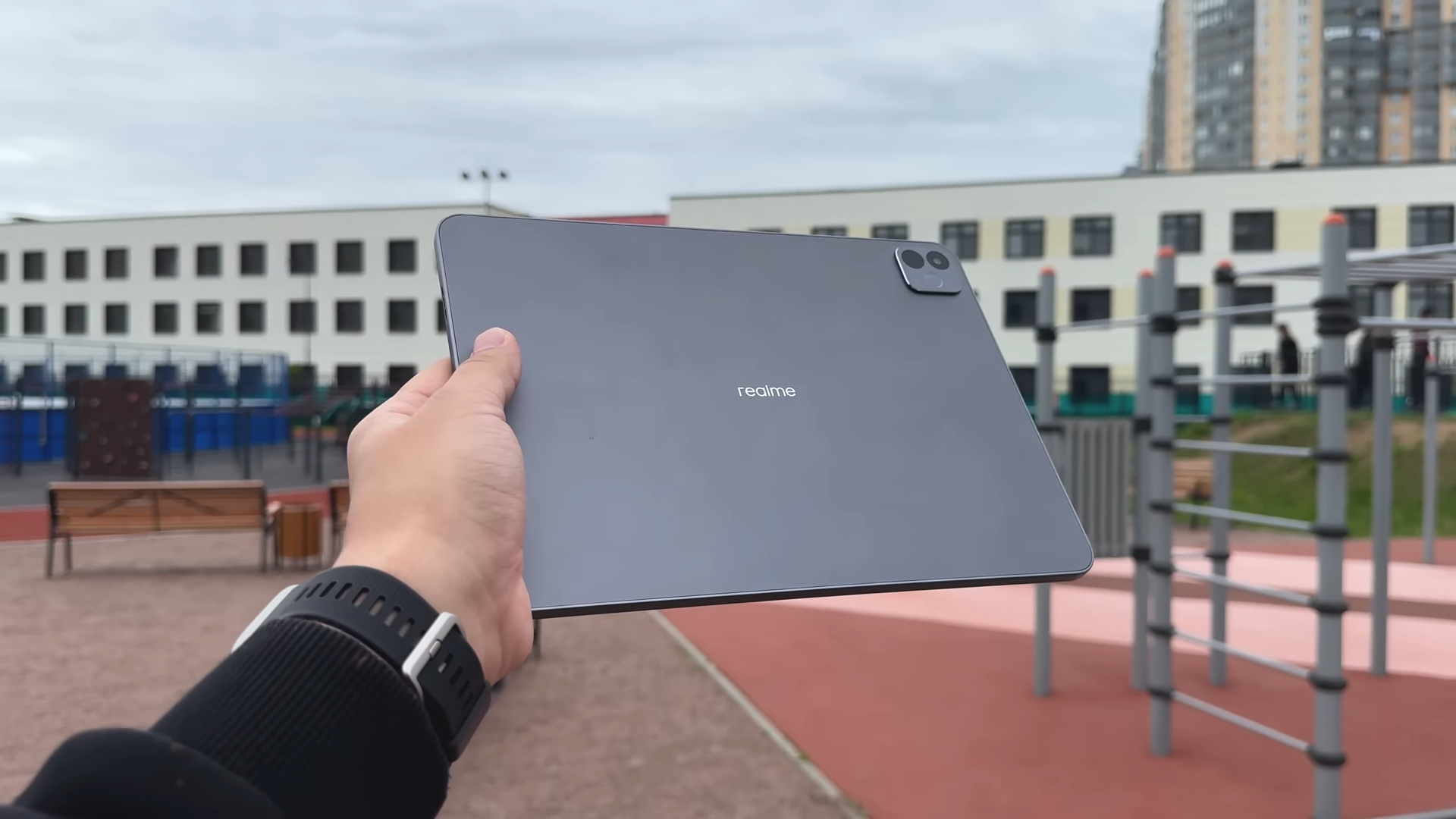
The device arrives in a robust, well-engineered box decorated with clear specifications. Inside the packaging, you will find the tablet itself, a basic user manual, a USB-A to USB-C charging cable, and a substantial 45W power adapter. The physical footprint measures 256 by 187 by 7 millimeters, with a total weight of 580 grams, making it feel substantial yet reasonably portable for extended sessions.
The chassis exhibits a premium aesthetic, utilizing an aluminum alloy backplate finished with a modern matte coating in either gold or grey color options. To ensure reliable wireless transmission for the cellular antennas, the manufacturer opted for a plastic perimeter frame instead of a full metal unibody. The overall construction remains highly rigid, showing zero signs of flexing, creaking, or bending under moderate pressure during physical handling.

Four-Speaker Audio Setup and Port Limitations
Symmetrically distributed across the outer edges of the aluminum frame are four stereo speakers designed to deliver spatial, room-filling sound. Software settings offer several audio presets to tune the acoustic output, though the system lacks a customizable graphic equalizer for precise user adjustments. The speakers get loud enough to fill a medium-sized room, but physical distortion becomes noticeable once the volume level exceeds approximately 75 percent.
Physical connectivity is handled by a single USB Type-C port utilizing the older USB 2.0 protocol, which lacks support for wired video output to external monitors. The power button doubles as a physical fingerprint reader, providing an incredibly reliable and rapid biometric security option. Wired audio enthusiasts will be disappointed by the complete absence of a 3.5-millimeter headphone jack, a legacy port increasingly reserved only for low-end budget tablets.

Display Specifications and Ergonomic Challenges
The visual experience relies on an 11.61-inch IPS LCD panel sporting a sharp 2.8K resolution of 2800 by 2000 pixels. This screen utilizes an 8-bit depth plus FRC color technology, yielding a density of 296 pixels per inch for crisp text reproduction. The unique 7:5 aspect ratio works exceptionally well for reading digital documents and browsing web pages, though it creates massive black bars when viewing modern widescreen cinematic content.
High-speed interactions feel fluid thanks to a 120Hz refresh rate combined with a responsive 240Hz touch sampling rate. The display registers up to ten simultaneous touch points accurately, though the ultra-thin bezels occasionally result in accidental palm inputs during hand-held operation. Brightness levels top out at a measured 460 nits under normal circumstances, boosting to a maximum of 550 nits under direct sunlight when the automatic brightness sensor is active.

Processing Power and Benchmark Data
Processing duties are managed by the MediaTek Dimensity 732 Max chipset, which is a surprisingly conservative octa-core processor built on a 4-nanometer process. Clock speeds peak at a modest 2.5 GHz, paired alongside the Mali-G615 MC2 graphics engine and 8GB of LPDDR4X system memory.
Storage options come in 128GB or 256GB capacities, with read and write speeds indicating the presence of a UFS 3.0 flash memory standard.

Intensive benchmarking reveals the processing limitations, with the device scoring a modest 835,000 points in the synthetic AnTuTu benchmark.
Geekbench 6 testing yields a single-core score of 1,007 points and a multi-core result of 3,113 points, alongside a GPU score of 2,057. An hour-long throttling test under 100 processing threads shows stable performance, averaging 330 GIPS with a minimum drop down to 310 GIPS under peak thermal stress.

Software Experience and Stylus Compatibility
The tablet runs on Realme UI 7, which is customized over the Android 16 base operating system. The interface feels highly responsive, offering multiple personalization options and productive multitasking features like split-screen layouts. There is also integration for Oasys Next services, which require a stable internet connection to function at their highest capacity.
Creative tasks can be performed using the official smart pen accessory, though its performance remains fairly basic and unextraordinary. Purchasing the stylus or the official keyboard case as standalone items is difficult to recommend due to their high retail pricing. Users intending to spend heavily on accessories would be better served investing that capital into more premium tablets offering integrated companion hardware.

Cellular Connectivity and Navigation Performance
The primary selling point of this hardware remains its hybrid slot, which supports either dual SIM cards or a single SIM paired with a MicroSD card up to 2TB. The onboard modem supports complete 5G connectivity alongside comprehensive band coverage for global 4G networks. This cellular capability allows the device to function as a fully autonomous communication tool or a large-format navigation unit without relying on smartphone tethering.
Location tracking is handled by a single-band GPS receiver that achieves an accuracy level ranging between one and four meters depending on local geography. Bluetooth 5.4 and Wi-Fi 5 are included for local wireless connections, though the system completely lacks any NFC hardware. The design lacks a physical proximity sensor, which occasionally results in awkward screen behavior when holding the tablet close to your face during voice calls.

Battery Performance and Charging Times
A massive 12,200 mAh battery powers the system, which should theoretically translate into class-leading endurance. The synthetic PCMark battery test yields a moderate runtime of 9 hours and 25 minutes, which is somewhat disappointing given the sheer physical size of the cell. Streaming high-definition YouTube videos over Wi-Fi at maximum screen brightness consumes 16 percent of the charge per hour, indicating high power draw from the display.
Gaming sessions further accelerate this power depletion, draining between 18 and 20 percent of the battery capacity per hour of active play. Recharging the large capacity cell from zero to full capacity takes 2 hours and 25 minutes using the included 45W charger. Wired reverse charging is also supported, allowing you to use this large tablet as a portable power bank for accessories or smartphones in an emergency.

Basic Camera Optics and Video Recording
The rear imaging system consists of a simple 8-megapixel sensor paired with an f/2.0 aperture and an integrated LED flash. The primary camera features autofocus capabilities, though the focus mechanism operates sluggishly and struggles to lock onto moving subjects. Video capture maxes out at a standard 1080p resolution at 30 frames per second, which is adequate for document scanning but poor for artistic video.
Self-portrait and video conferencing tasks are handled by a front-facing 8-megapixel camera that features a fixed-focus design and an f/2.0 aperture. The front sensor matches the rear camera’s maximum video output of 1080p at 30 frames per second with decent exposure. Image quality remains highly utility-focused, with low dynamic range and noticeable noise appearing in anything other than optimal studio lighting.

Final Thoughts — Price & Value
The decision to purchase the Realme Pad 3 5G hinges entirely on your specific need for standalone cellular data. At a typical market price of $459 price tag, the modest processing capability of the Dimensity 732 Max chipset represents a poor value proposition compared to processing powerhouses like the Xiaomi Pad 8. The device shines solely as an affordable, large-screen communications hub because other major manufacturers deliberately exclude SIM card slots from their mid-range tablets to force customers into more expensive smartphone purchases.
A fingerprint scanner in the power button and robust cellular networking are the two primary pillars supporting the value of this hardware. Consumers looking for pure gaming performance or professional-grade display quality will find better longevity in alternatives like the OnePlus Pad or premium Honor offerings. This particular model serves a narrow niche of users who require constant internet connectivity on a budget-friendly large display without dealing with the hassle of mobile hotspots.
