

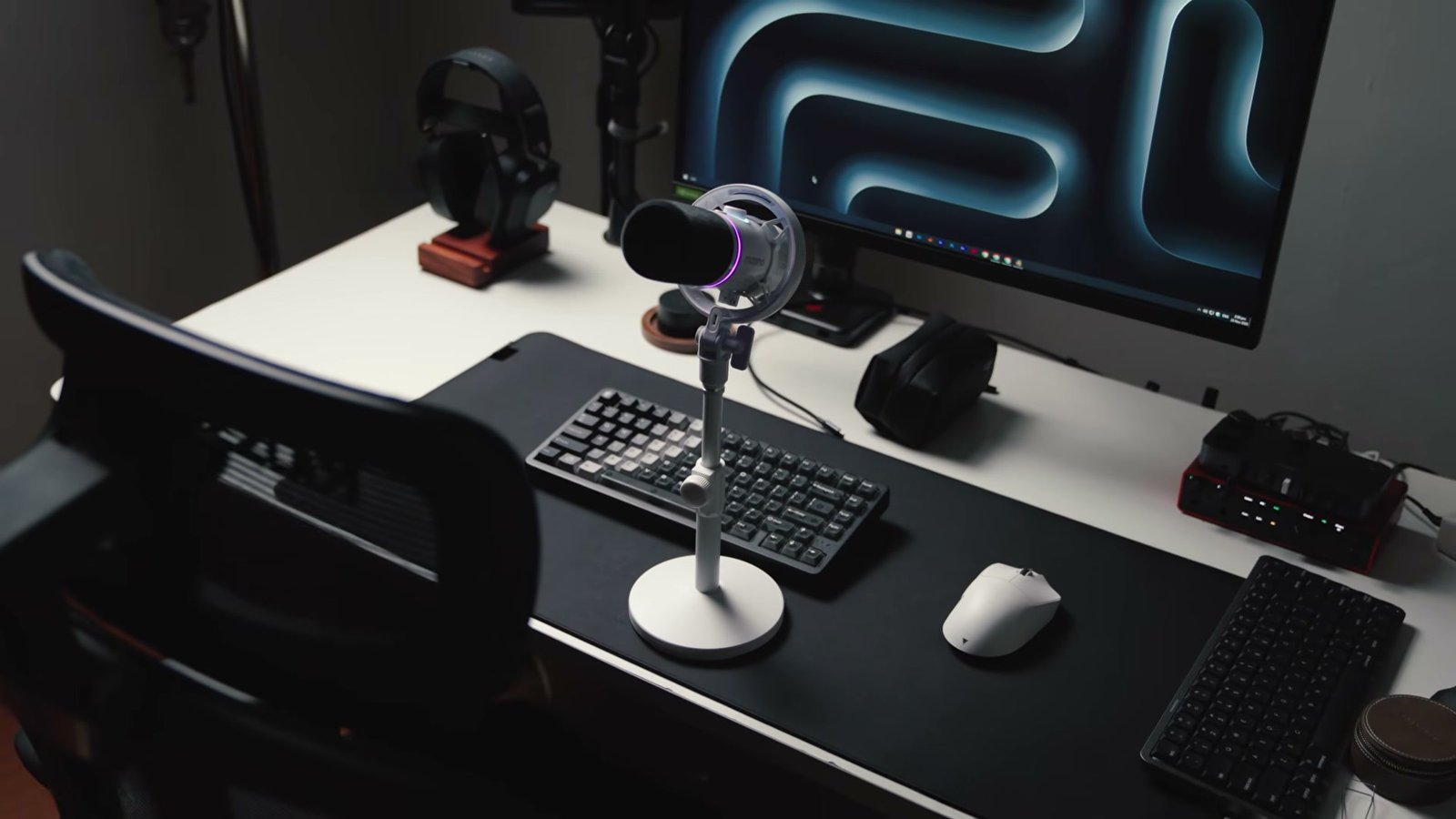
Most desktop podcast microphones force creators to pick between wired XLR studio rigs and plug-and-play USB cables. Priced around $99.99 to $119.99 on Amazon and AliExpress, the Maono PD200W eliminates that compromise by combining 2.4GHz wireless, USB-C, and analog XLR inside one dynamic broadcast body. Its built-in 2,600mAh battery even promises up to 60 hours of cable-free recording.
I tested the Maono PD200W across 2.4GHz wireless desk recording, wired USB-C sessions, and XLR interface routing. I also evaluated its onboard 3-in-1 gain knob, 3-level environmental noise cancellation, and Maono Link DSP software. Here is how this hybrid dynamic mic performs in daily creator workflows.
Maono PD200W
The Good (Pros)
- Tri-mode connectivity (2.4GHz Wireless, USB-C, and XLR)
- Up to 60 hours of battery life with RGB off
- 30mm cardioid dynamic capsule with 82 dB SNR and 128 dB max SPL
- Integrated shock mount, 3-in-1 control knob, and Maono Link DSP
The Bad (Cons)
- RGB ring disables automatically in pure XLR mode
- Desktop stand adds weight when traveling compared to clip-on mics
Technical Specifications
| Specification | Maono PD200W |
|---|---|
| Capsule Type | 30mm Dynamic Cardioid |
| Connectivity | 2.4GHz Wireless, USB-C, Analog XLR |
| Audio Resolution | 24-bit / 48kHz (USB-C & Wireless) |
| Frequency Response | 50 Hz – 16,000 Hz |
| Signal-to-Noise Ratio | 82 dB (128 dB Max SPL) |
| Wireless Range | Up to 60m Line-of-Sight (2 TX + 1 RX Support) |
| Battery Capacity | 2,600mAh (60h RGB Off / 38h RGB On) |
| Controls & Monitoring | 3-in-1 Gain/Volume Knob, One-Tap Mute, 3-Level ENC, 3.5mm Jack |
| Software & Lighting | Maono Link App DSP + 16.8M-Color RGB Ring |
| Typical Price | $99.99 – $119.99 |
Shock-Mounted Chassis & Build Quality

Maono wraps the PD200W in a clean broadcast cylinder suspended inside a rigid integrated shock mount. That suspension isolates desk bumps and keyboard vibrations before they reach the 30mm cardioid dynamic capsule. Around the grille sits a 16.8M-color RGB accent ring that adds subtle studio flair without looking distracting on camera. Weight distribution on the matching desktop base feels planted and steady during long recording sessions.
Tri-Mode Connectivity: 2.4GHz Wireless, USB-C & XLR

Flipping the microphone around reveals why the PD200W stands out from standard USB mics. You get a full-size 3-pin XLR jack for audio interfaces, a USB-C port for direct PC or Mac capture, and a 3.5mm zero-latency headphone jack. In 2.4GHz wireless mode, the compact receiver pairs directly with cameras, phones, or computers up to 60 meters line-of-sight and even supports dual-transmitter co-hosted setups.

Switching to XLR lets you bypass internal digital circuitry and feed your favorite preamp or mixer directly. I noticed that RGB lighting turns off automatically in pure XLR mode to keep the analog signal path clean and power-free. That thoughtful design means you can start with wireless or USB-C today and scale into a full XLR studio desk later without replacing your microphone.
Onboard Controls, Battery Life & Maono Link DSP

Front-facing hardware controls keep adjustments effortless mid-stream without opening software menus. The 3-in-1 multi-function knob smoothly dials microphone gain and headphone monitoring volume, while a dedicated one-tap mute button prevents accidental live coughs. A 3-level hardware environmental noise cancellation toggle tames room hum right from the chassis. Power comes from a 2,600mAh internal battery rated for 60 hours with RGB off or 38 hours with lighting enabled.

Opening Maono Link on desktop unlocks deeper tonal shaping for USB-C and wireless modes. I tuned the EQ presets, dialed in AI noise reduction, and customized RGB colors in seconds without fighting cluttered menus. Combined with 24-bit/48kHz digital resolution and 128 dB max SPL handling, vocal tracks stay warm, punchy, and free from clipping.

In daily desk use, the cardioid dynamic capsule rejects background keyboard clatter and room echo effectively. Even without acoustic foam panels on every wall, voice recordings sound focused and broadcast-ready straight out of the box. Moving the mic around the desk without dragging heavy cables makes filming B-roll and standing streams noticeably cleaner.
💡 Recommended Alternatives: Compare this wireless hybrid mic against the more affordable Maono PD100W, check out the ultra-compact Maono Wave T1 Mini for mobile vlogging, and browse all tested mics in our Microphones Hub.

Maono PD200W Hybrid Wireless Dynamic Microphone
- 2.4GHz Wireless + USB-C + XLR
- 24-bit/48kHz & 60h Battery Life
- 30mm Cardioid Dynamic Capsule
- 3-Level ENC & Maono Link DSP
Final Thoughts — Price & Value
At $99.99 to $119.99, the Maono PD200W delivers rare versatility that few desktop microphones can match. Packing 2.4GHz wireless, USB-C, and XLR into one shock-mounted dynamic body saves creators from buying separate studio and mobile mics. With 60-hour battery endurance and clean 24-bit/48kHz audio, the price-to-performance ratio is genuinely compelling.
Buy it if you want a cable-free desktop podcast microphone that still plugs into XLR interfaces whenever your studio grows. Skip it if you prefer a featherweight clip-on lavalier for outdoor run-and-gun filming. You can check current deals on Amazon or compare bundle pricing on AliExpress.
Frequently Asked Questions
Can the Maono PD200W work wirelessly and over XLR?
Yes, the Maono PD200W supports 2.4GHz wireless transmission, wired USB-C, and traditional 3-pin analog XLR. You can record wirelessly to a PC, phone, or camera via the receiver, or plug straight into an audio interface via XLR. RGB lighting automatically turns off in pure XLR mode.
How long does the Maono PD200W battery last?
The built-in 2,600mAh rechargeable battery lasts up to 60 hours with the RGB ring switched off. Turning the customizable 16.8M-color RGB lighting on still provides up to 38 hours of continuous wireless recording. Recharging happens through the rear USB-C port.
Does the Maono PD200W support dual-mic podcasting?
Yes, its 2.4GHz wireless system supports up to two transmitters paired to a single receiver. That makes co-hosted podcasts and two-person interviews simple without running long XLR cables across a table. Each microphone also includes onboard gain, mute, and 3-level noise cancellation.
