

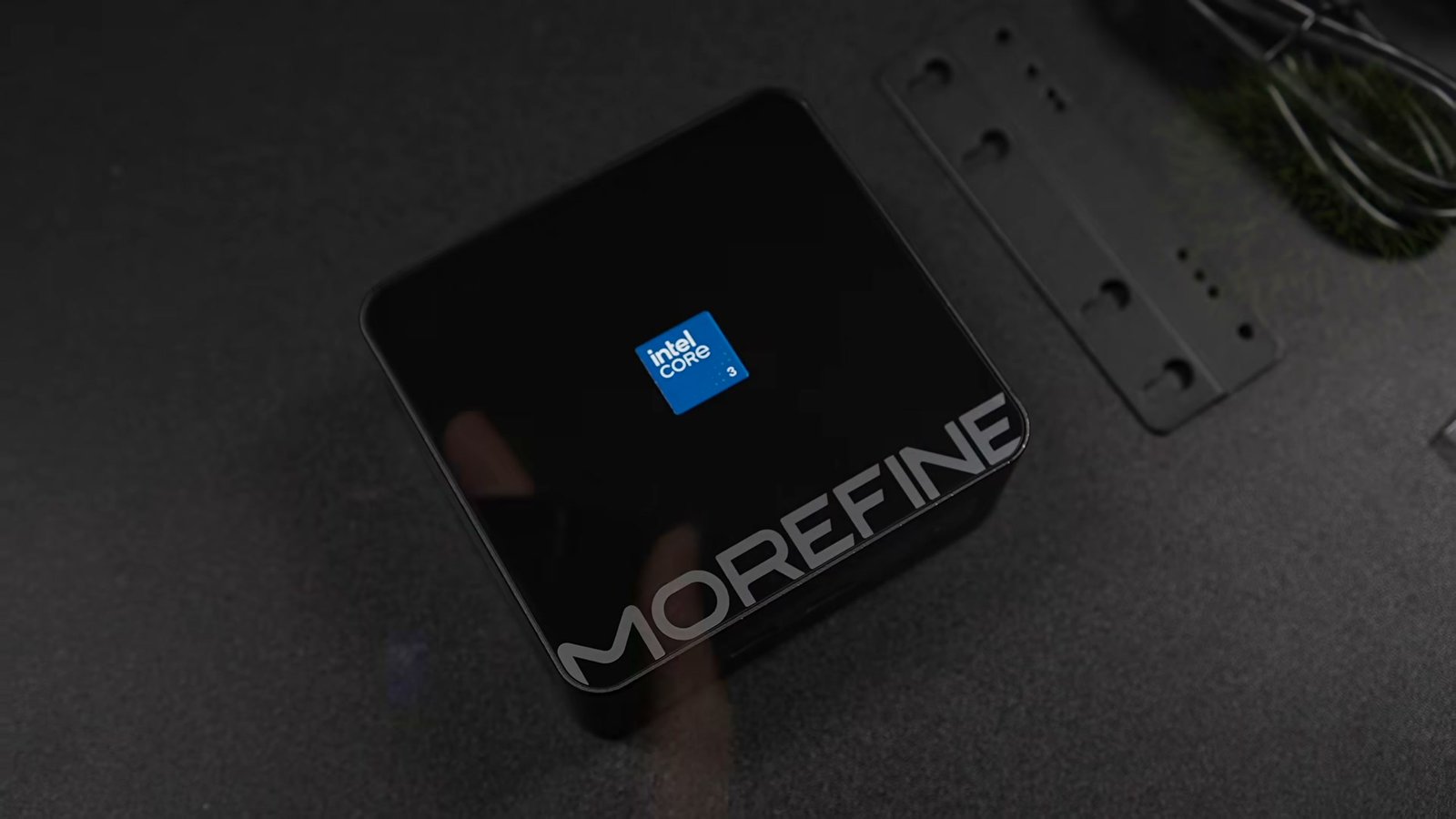
The Morefine M9 Pro enters the ultra-compact desktop segment with Intel’s new Core 3 304 Wildcat Lake architecture. Starting near $379.00 barebones and around $476.88 for configured storage listings on AliExpress, it targets everyday desktop buyers who want snappier responsiveness than budget N100 and N150 boxes. Noticeably, even the barebones tier includes 12GB of onboard LPDDR5 memory so builders only need an NVMe drive to get running.
Hands-on testing examines chassis ergonomics, front and rear I/O bandwidth, dual M.2 2280 storage accessibility, and unlocked BIOS power tuning. Sustained CPU and GPU stress benchmarks measure package power draw, acoustic fan behavior, and single-core uplift against Alder Lake-N chips. Real-world tests also verify light PC gaming and 1080p console emulation across PS2, GameCube, Wii, and 3DS.
Morefine M9 Pro Mini PC
The Good (Pros)
- Intel Core 3 304 (Wildcat Lake) delivers 2,199 Geekbench single-core—80% faster than Intel N150
- Includes 12GB soldered LPDDR5-5600 memory even on the $379 barebones configuration
- Dual full-size M.2 2280 NVMe SSD slots support easy two-drive internal storage expansion
- Rear I/O packs 40Gbps USB4 Type-C, dual HDMI 2.0, and a 2.5GbE RJ45 Ethernet port
- Unlocked BIOS power profiles let users switch seamlessly between Quiet, Balanced, and High Performance (22W TDP)
- Handles 1080p PS2, GameCube, Wii, and 3DS emulation comfortably under 15W package power
The Bad (Cons)
- 12GB LPDDR5 memory is soldered to the motherboard with zero RAM upgrade slots
- Single Xe3 iGPU core (1,982 3DMark Fire Strike) limits modern 3D PC titles to 720p low settings
- Barebones listing omits an M.2 SSD, requiring buyers to supply or buy a configured NVMe SKU
Quick Navigation (Table of Contents)
- Morefine M9 Pro Technical Specifications
- Ultra-Compact Footprint, Desk Hardware & Front USB 3.2 I/O
- Rear I/O Architecture: 40Gbps USB4, Dual HDMI 2.0 & 2.5G LAN
- Internal Layout, 12GB LPDDR5-5600 & Dual M.2 2280 Expansion
- Unlocked Aptio BIOS Power Profiles & 22W Sustained Stress Thermals
- Intel Core 3 304 Synthetic Benchmarks vs N305 & N150
- Xe3 Graphics Jump, 15W PC Gaming & 1080p Console Emulation
- Recommended Alternatives in Mini PCs
- Final Thoughts — Price & Value Verdict
- Frequently Asked Questions (Morefine M9 Pro)
Morefine M9 Pro Technical Specifications
| Hardware Specification | Morefine M9 Pro Measured Detail |
|---|---|
| Processor (CPU) | Intel Core 3 304 (Wildcat Lake, 5 Cores / 5 Threads: 1 P-Core up to 4.3GHz + 4 LP E-Cores up to 3.3GHz) |
| Integrated GPU | Intel Xe3 iGPU (1 Compute Unit up to 2.3GHz, up to 6.6GB shared memory) |
| System Memory | 12GB Onboard LPDDR5 @ 5,600 MT/s (Soldered Dual-Channel) |
| Storage Expansion | 2× M.2 2280 NVMe PCIe SSD Slots (512GB Kioxia NVMe on tested unit) |
| Sustained TDP & Temps | 21W–22W Max Combined Stress TDP (High Performance Mode, ~77°C–79°C) |
| Front I/O Ports | 2× USB 3.2 Type-A, Recessed Power Button |
| Rear I/O Ports | 1× USB4 (40Gbps), 2× HDMI 2.0, 2× USB 3.2 Type-A, 1× 2.5GbE RJ45 LAN, 3.5mm Audio, DC-In |
| Wireless Networking | Wi-Fi 6 + Bluetooth 5.2 (M.2 Wireless Card) |
| Geekbench / 3DMark | 2,199 Single-Core / 5,943 Multi-Core / 1,982 3DMark Fire Strike |
Ultra-Compact Footprint, Desk Hardware & Front USB 3.2 I/O
Morefine packages the Morefine M9 Pro inside a remarkably small matte enclosure that occupies minimal desk space. A subtle VESA mounting bracket and hardware kit arrive inside the box alongside a six-foot HDMI cable and compact power brick. Front-facing connectivity keeps daily peripherals effortless to reach with twin full-size USB 3.2 Type-A ports sitting beside the power button.
Clean side panels remain solid to keep airflow channeled directly from the intake vents toward the internal blower. Placing the unit behind a monitor or tucked beneath a display riser leaves the workspace virtually clutter-free. Matte surfaces handle frequent USB plugging without showing unsightly scratches.

Rear I/O Architecture: 40Gbps USB4, Dual HDMI 2.0 & 2.5G LAN
Connectivity along the rear panel punches far above typical entry-level mini desktops. Users get a high-speed USB4 Type-C port running at 40Gbps alongside dual HDMI 2.0 outputs for triple-display multi-monitor productivity. Networking and legacy gear are covered by a 2.5-gigabit RJ45 Ethernet jack, two additional USB 3.2 ports, a 3.5mm audio combo jack, and the barrel DC power input.
Having true 40Gbps USB4 bandwidth unlocks fast external NVMe scratch drives and single-cable Thunderbolt-class docking convenience. Dual HDMI 2.0 ports drive crisp 4K 60Hz panels out of the box without adapters. Combined with integrated Wi-Fi 6 and Bluetooth 5.2, desk wiring stays minimal and fast.

Internal Layout, 12GB LPDDR5-5600 & Dual M.2 2280 Expansion
Opening the bottom chassis requires loosening just four standard screws to expose the entire upgrade bay. Inside sits a dual M.2 2280 NVMe slot layout allowing buyers to install two full-length SSDs side by side for multi-terabyte capacity. Pre-configured units ship with a Kioxia 512GB NVMe drive installed in the primary slot, leaving the secondary bay open for fast expansion.
Memory utilizes 12GB of LPDDR5 running at 5,600 MT/s soldered directly onto the mainboard. While non-upgradeable RAM limits heavy workstation scaling, 5,600 MT/s bandwidth feeds both Windows 11 multitasking and integrated graphics cleanly. Up to 6.6GB of system memory dynamically allocates to video memory when graphical workloads ramp up.

Unlocked Aptio BIOS Power Profiles & 22W Sustained Stress Thermals
Booting into the Aptio AMI BIOS reveals granular hardware controls often locked down on competing low-power mini PCs. Users can switch the Power Limit Select setting directly between Quiet, Balanced, and High Performance modes depending on thermal or acoustic priorities. Advanced menus also expose Turbo options, CPU VR settings, and automatic smart fan curves for fine-grained tuning.
Under combined CPU-Z and GPU-Z stress loads in High Performance mode, total package TDP peaks smoothly at 21W to 22W sustained. CPU-only workloads settle near 17W to 18W while keeping core temperatures steady around 77°C to 79°C. Fan noise remains mild and unobtrusive, avoiding the high-pitched whine common in thinner fanless shells.

Intel Core 3 304 Synthetic Benchmarks vs N305 & N150
Synthetic benchmarks highlight why Intel's Wildcat Lake Core 3 304 stands apart from budget N-series processors. Its five-core hybrid layout pairs one Performance core boosting up to 4.3GHz with four low-power Efficiency cores clocking up to 3.3GHz. In Geekbench 7.0 AVX2 single-core testing, the Morefine M9 Pro scores 2,199 points—an 80% leap over the Intel N150 (1,004) and comfortably ahead of the Intel N305 (1,225).
Multi-core performance reaches 5,943 points despite having only five threads, posting a 38% uplift over the N150 and surpassing the eight-core N305 (4,299). Everyday Windows 11 browsing, Office productivity, and photo adjustments feel noticeably snappier with zero micro-stutter. Built-in NPU acceleration also assists light Windows AI background offloading without taxing the P-core.

Xe3 Graphics Jump, 15W PC Gaming & 1080p Console Emulation
Graphics throughput relies on Intel's new Xe3-based integrated GPU equipped with one compute unit clocking up to 2.3GHz. In 3DMark Fire Strike benchmarks, it posts 1,982 points, beating the Intel i3-N305 (1,524) by 30% and outpacing the Intel N100 (1,148). Source-engine titles like Left 4 Dead 2 average 108 FPS at 1080p High under 15W TDP, though heavier titles like original Skyrim require 720p to stay near 60 FPS.
Console emulation is where the Morefine M9 Pro punches far above its compact power envelope. PCSX2 PS2 emulation holds a locked 60 FPS at 1080p DX12 across fighting and racing classics, while Dolphin runs Wii titles cleanly at 1080p and GameCube at 720p–1080p. Even 3DS titles via Azahar Vulkan run full-speed at 1080p while total package power stays below 15 watts.

Recommended Alternatives in Mini PCs
- Beelink EQ14 (Intel N150): A lower-cost office and media mini desktop offering quiet daily operation and dual HDMI displays when maximum single-core speed is not required.
- GMKtec NucBox G5 / G3 Plus: Ultra-affordable Alder Lake-N pocket mini PCs tailored for home servers, basic browsing, and lightweight retro emulation under $200.
- Minisforum UM760 Slim (Ryzen 5 7640HS): A stronger mid-range Radeon 760M RDNA3 option for buyers needing upgradeable DDR5 RAM and higher 1080p PC gaming framerates.
Final Thoughts — Price & Value Verdict
The Morefine M9 Pro proves that entry-tier mini PCs no longer need sluggish single-core responsiveness to hit sub-$400 barebones pricing. Retailing near $379.00 barebones and around $476.88 pre-configured on AliExpress, it delivers 40Gbps USB4, dual M.2 2280 slots, and 12GB LPDDR5 memory in a palm-sized box. Combining an 80% single-core jump over the N150 with quiet 22W thermals gives it standout daily value.
Pick up the Morefine M9 Pro on AliExpress or Amazon to get snappy Core 3 304 desktop speed, 40Gbps USB4, dual NVMe bays, and 1080p retro emulation in a tiny footprint. Skip this machine if you need 32GB+ upgradeable RAM or native 1080p performance in modern AAA PC releases. For compact home offices, media setups, and 15W emulation rigs, it stands as a remarkably capable mini PC.

Morefine M9 Pro Mini PC (Intel Core 3 304)
- Intel Core 3 304 Processor (5 Cores: 1 P-Core 4.3GHz + 4 LP E-Cores)
- 12GB Soldered LPDDR5-5600 Memory (Shared with Xe3 iGPU)
- Dual M.2 2280 NVMe SSD Expansion Slots
- USB4 40Gbps Type-C, Dual HDMI 2.0 & 2.5Gbps Ethernet
- Wi-Fi 6, Bluetooth 5.2 & Unlocked 22W BIOS Power Modes
Frequently Asked Questions (Morefine M9 Pro)
Can you upgrade the RAM on the Morefine M9 Pro?
The 12GB of LPDDR5-5600 memory is soldered directly to the motherboard, so there are no SO-DIMM slots for RAM expansion. However, even the $379 barebones version ships with this 12GB memory included out of the box. Buyers only need to add an M.2 2280 NVMe SSD if choosing the barebones model.
How fast is the Intel Core 3 304 compared to the Intel N150 and N305?
In Geekbench 7.0 AVX2 benchmarks, the Core 3 304 reaches 2,199 single-core and 5,943 multi-core. That delivers an 80% single-core boost and 38% multi-core gain over the Intel N150 while still beating the N305 in both workloads. Graphics performance also climbs 30% ahead of the i3-N305 in 3DMark Fire Strike.
What kind of gaming and emulation can the Morefine M9 Pro run?
Older PC titles like Left 4 Dead 2 exceed 100 FPS at 1080p High settings while consuming under 15 watts. Retro console emulation shines with PCSX2 PS2, Dolphin Wii/GameCube, and Azahar 3DS titles running smoothly at 720p to 1080p. Modern demanding AAA PC releases exceed what the single Xe3 GPU core is built to handle.
