

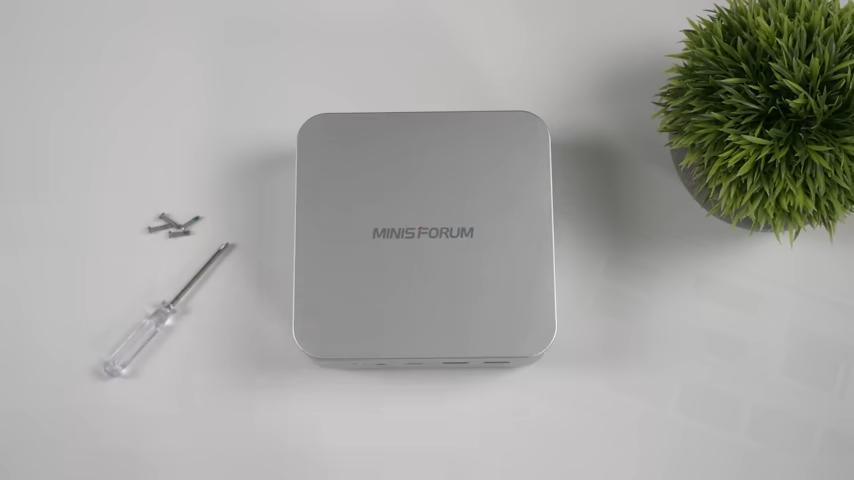
The Minisforum M2 arrives as a high-performance, compact computing solution positioned as the most cost-effective barebones Panther Lake mini PC currently available. Featuring the Intel Core Ultra 7 356H processor, this machine targets users who prioritize a small footprint without sacrificing raw processing capabilities.
Price points vary depending on the configuration, with significant savings realized by sourcing your own DDR5 SODIMM RAM and M.2 storage. Minisforum maintains its reputation for sleek hardware design here, delivering a chassis that fits comfortably into any workstation or entertainment setup while providing robust connectivity options.

Physical Connectivity, Design, and Internal Expansion Capabilities
The M2 utilizes a compact plastic chassis that maximizes desk space without feeling fragile. Upfront, the unit offers a 3.5mm audio jack, two USB 3.2 Gen 2 ports, and a versatile USB 4 port capable of 40Gbps protocols, effectively serving as an unlicensed Thunderbolt 4 interface. Ventilation is integrated along the sides and bottom, with the rear housing dual 2.5Gb Ethernet ports, full-size DisplayPort 1.4, HDMI 2.1, and additional USB connectivity.

Accessing the internals is a straightforward process requiring the removal of four bottom screws. Beneath the cover lies a dedicated cooling system for the RAM and dual PCIe 4.0 M.2 slots, ensuring components remain stable under load. Providing the barebones unit with dual-channel DDR5 5600MT/s RAM is highly recommended to unlock the full potential of the Intel architecture.

Processor Benchmarks and Thermal Performance Profiles
Powering this system is the Intel Core Ultra 7 356H, a chip featuring 16 cores and 16 threads—consisting of four performance cores, eight efficiency cores, and four low-power efficiency cores. During sustained workloads, the system exhibits impressive power management, frequently spiking to 60 watts before settling into a sustained 54-watt TDP. This output exceeds the official 45-watt rating provided by the manufacturer, granting the processor additional headroom for higher clock speeds.

Performance metrics in Geekbench 6 show a single-core score of 2,696, standing toe-to-toe with more expensive high-end alternatives. Cinebench R24 further highlights the chip’s efficiency, yielding a single-core score of 118, which outperforms several legacy platforms. While multi-core results are capped by the core count, the unit manages demanding tasks with consistent stability, proving that Panther Lake remains a formidable choice for modern computing.

Intel Arc Integrated Graphics and Advanced Scaling Technologies
Graphics duties are handled by the integrated Intel Arc GPU, equipped with four XE3 cores clocked at 2,450MHz. Despite being a lower-tier configuration compared to flagship variants, the iGPU benefits immensely from Intel’s latest driver updates and advanced scaling features. With 32GB of system RAM installed, the BIOS automatically allocates 18GB as dedicated video memory, significantly boosting performance in graphical tasks.

3D Mark Time Spy testing results in a score of 3,273. This confirms that while the hardware is not intended to replace a dedicated desktop GPU, it handles modern gaming comfortably. The inclusion of Intel’s multi-frame generation technology, which can be overridden via the graphics software to apply to games supporting XESS 1.1 or higher, allows for substantial frame rate increases that breathe new life into demanding titles.

Real-World Gaming Performance and Scaling Success
Gaming performance on the M2 surprises in real-world scenarios. In Cyberpunk 2077, utilizing XESS frame generation and the Steam Deck preset, the unit maintains smooth playability at 1080p resolution. Disabling traditional scaling while keeping frame generation active delivers surprisingly fluid results, pushing frame rates well beyond expected thresholds for an integrated graphics solution.

Testing with Crimson Desert reveals the limitations of the hardware at higher presets, though dropping to 900p provides a stable experience. Titles lacking internal XESS support still perform admirably at 1080p on low settings with ultra-quality textures. The power efficiency remains a standout feature, as the system consumes roughly 30 watts during intensive gameplay, cementing its status as an exceptionally efficient compact gaming device.

Final Thoughts — Price & Value
The Minisforum M2 stands out as the most budget-friendly entry point for users wanting to experience Panther Lake architecture. By opting for the barebones version and utilizing existing components, users avoid the premiums typically attached to fully configured mini PCs, resulting in a system that delivers impressive performance per dollar spent.
Value is further bolstered by the inclusion of modern connectivity, such as Wi-Fi 7 and dual 2.5Gb Ethernet, which future-proofs the unit for most home and office environments. While the chassis is plastic rather than aluminum, the internal cooling design and the ability to leverage Intel’s latest scaling software provide a polished user experience that exceeds the limitations of its small form factor.

Choosing this hardware makes sense for those who appreciate the flexibility of a DIY approach combined with the latest in Intel’s mobile processing tech. Whether for gaming, emulation, or general productivity, the M2 provides a balanced, high-performance package that maintains a competitive edge in the crowded mini PC market.
