

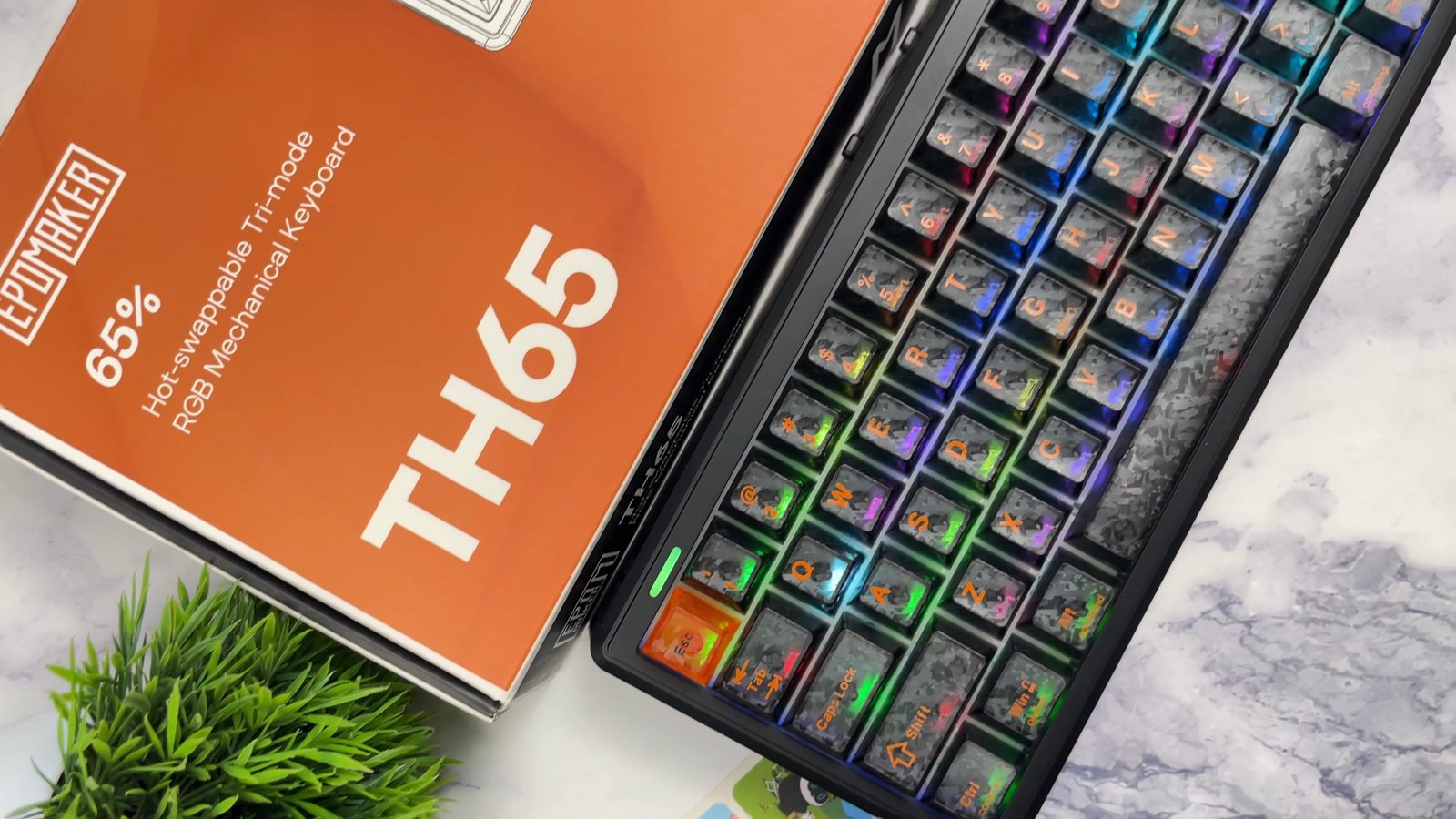
The mechanical keyboard market frequently sees budget boards compromise on internal construction or acoustic dampening to maintain competitive pricing. Epomaker approaches the 65% form factor with the TH65 by integrating enthusiast-grade internals into an accessible daily driver. Retailing between $65 and $66 across the official store and AliExpress, this keyboard brings premium construction choices directly to the entry-level segment.
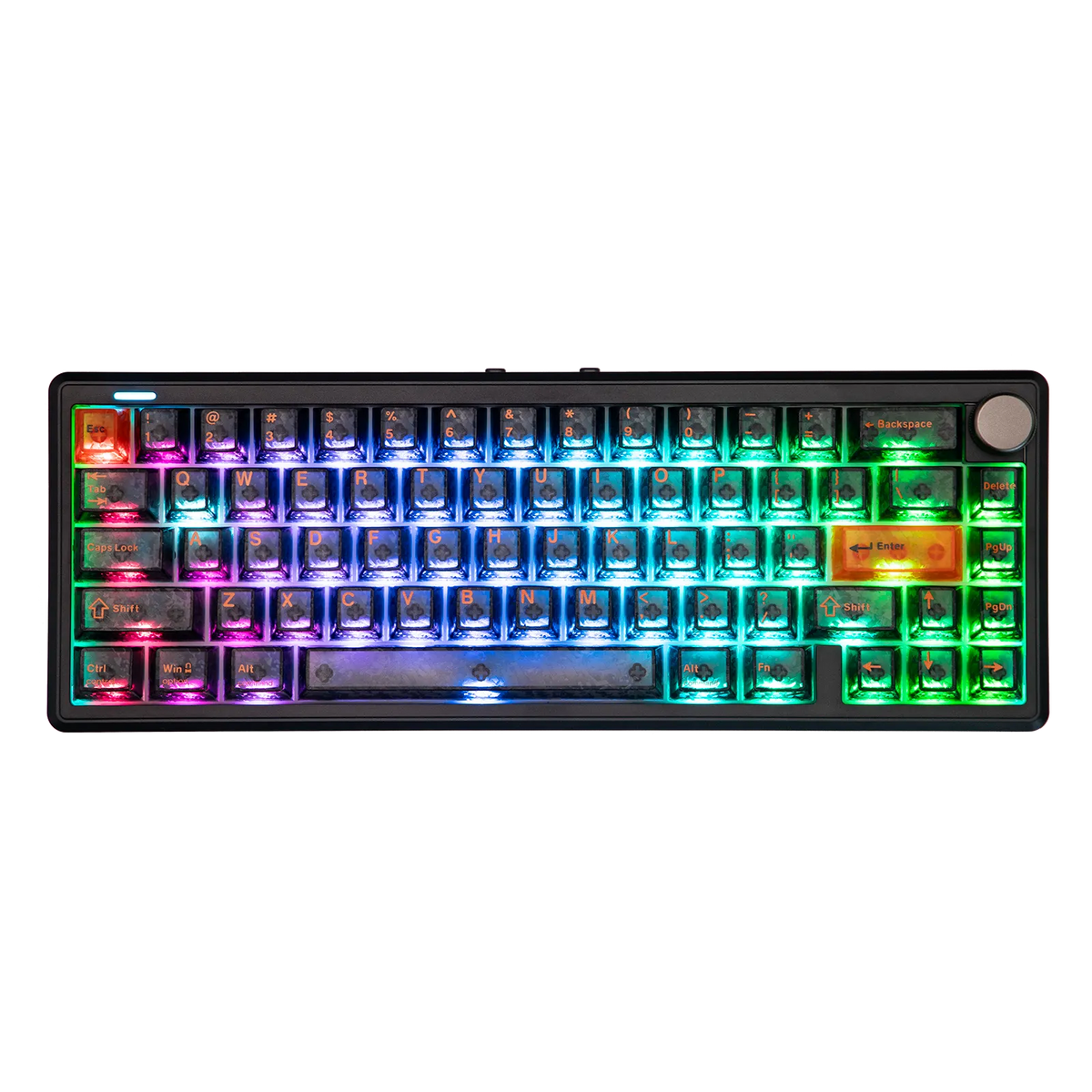
Epomaker TH65
- 65% Compact Mechanical Keyboard
- Gasket Mount
- Tri-Mode Connectivity
- 5-Layer Sound Optimization
I spent extensive time testing this unit across daily typing workloads and general desktop use to examine how well its feature set holds up. The compact 66-key footprint aims to save valuable desk space while preserving essential navigation arrows and a dedicated volume encoder. My focus centers on evaluating the actual value of its multi-layered dampening, flexible mounting system, and massive internal battery.
Case Design and Ergonomics
The exterior housing utilizes impact-resistant ABS plastic formed into a clean, minimalist 65% shell weighing approximately 700 grams. This weight gives the chassis a dense, reassuring presence on the desk without creating unnecessary heft in a daily carry bag. On the underside, Epomaker added a decorative mirrored metal badge displaying factory specifications, operating current, and battery metrics.

Ergonomic comfort remains a priority thanks to a front typing height measuring 18.5 millimeters and a rear elevation of 32 millimeters. Two-stage rubberized feet provide three distinct inclination angles set at 6, 8, and 10.5 degrees. I found the lower typing angle comfortable for long typing sessions even without using a dedicated wrist rest.
A tactile rotary knob machined from metal sits in the upper right corner to control system volume and instant audio muting. The dial features distinct mechanical stepping with tactile detents rather than free-spinning motion, which prevents erratic volume jumps. Underneath one of the rear folding feet, Epomaker placed a hidden magnetic stowage slot to secure the 2.4 GHz wireless receiver during transit.

Internal Structure and Acoustic Dampening
The core strength of the TH65 lies in its gasket-mount suspension and flexible polycarbonate plate design. This plate features precision flex cuts around key clusters, granting subtle vertical travel with every keystroke. Typing on this assembly produces a softened bottom-out impact that significantly reduces finger fatigue over full workdays.
Epomaker engineered a comprehensive five-layer acoustic sandwich to eliminate hollow chassis resonance and metallic pinging. The stack integrates Poron sandwich foam, dedicated switch pads, a specialized PET sound-optimizing sheet, a socket dampening film, and a heavy bottom silicone mold. These materials work together to absorb stray vibrations and redirect energy toward the switches themselves.

I noticed that the plate-mounted stabilizers come lubricated from the factory with sufficient consistency to minimize wire rattle. Combined with the extensive dampening array, the spacebar and larger modifier keys deliver a deep, subdued sound profile without unwanted clatter. The internal density transforms what could have been a loud plastic enclosure into a solid acoustic chamber.
Switch Selection and Keycap Profiles
Epomaker sells the TH65 with three distinct factory-lubricated mechanical switch options to accommodate diverse typing preferences. Buyers can select the linear Creamy Jade switches for a deep thocky acoustic signature, the Epomaker Clear linear switches for gaming response, or the Epomaker Crystal Silent switches. My test model came equipped with the Crystal Silent switches, which operate as semi-silent tactile mechanisms designed specifically for noise-sensitive workspaces.

The Crystal Silent switches dampen mechanical contact noise to near-complete silence while retaining a gentle tactile bump. Keystrokes produce almost zero audible clatter, making this configuration ideal for late-night typing sessions or shared office environments. Because the PCB supports 3-pin and 5-pin hot-swappable sockets, swapping these switches for alternate options requires only the included extraction tool.
Keycap materials differ depending on the selected colorway across the Retro White, Black, and Pink models. The Retro White version ships with durable double-shot PBT keycaps molded in a standard Cherry profile. The Black version utilizes tinted polycarbonate keycaps with silk-screened legends, allowing south-facing RGB lighting to diffuse softly through the key walls.

Triple Connectivity and Gaming Latency
Hardware switches along the rear panel govern operating mode and system compatibility between Windows and macOS. The connection toggle allows seamless switching between wired USB-C, 2.4 GHz wireless via the bundled dongle, and multi-device Bluetooth. The operating system toggle instantly remaps modifier keys so Mac users do not have to reprogram layout profiles manually.
Wireless performance over the 2.4 GHz connection proved exceptionally stable with a responsive 1000 Hz polling rate. Wired operation matches this 1000 Hz polling rate while yielding an ultra-low input latency of roughly 2.5 milliseconds. Bluetooth mode reduces the polling rate to 125 Hz with latency increasing to 11 milliseconds, which serves office work well while conserving internal battery reserves.

In practical gaming scenarios, the TH65 handles casual multiplayer titles and everyday gaming without missed inputs or dropped signals. Serious competitive esports players must note that this board uses traditional mechanical switches without magnetic rapid-trigger or dynamic keystroke features. The hardware performs reliably within traditional mechanical boundaries, offering anti-ghosting and consistent actuation.
Battery Longevity and Power Management
A standout engineering achievement on the TH65 is the inclusion of an enormous 8000mAh rechargeable lithium battery pack. Most compact 65% mechanical keyboards on the market pack batteries between 2000mAh and 4000mAh to reduce assembly costs. Packing double that capacity gives this board unprecedented endurance in daily cord-free setups.
Epomaker rates the operational lifespan at up to 150 hours of continuous wireless usage with the RGB backlighting disabled. In my testing routine across daily working sessions, a single charge easily carries through several weeks without low-power warnings. When recharging becomes necessary, the USB-C port supports 15W fast charging to replenish the cell rapidly from compatible chargers or host ports.

Power conservation timers can be tweaked through the software to shut down the LED array during idle desk periods. This standby management ensures the battery avoids unnecessary discharge when stepping away from the desk. The substantial cell adds functional weight to the base, providing physical stability while eliminating battery anxiety.
RGB Illumination and Web Driver Functionality
The keyboard incorporates south-facing per-key RGB illumination featuring diverse dynamic effects such as static colors, flowing gradients, and customizable patterns. South-facing diodes ensure seamless keycap compatibility without mechanical interference across different Cherry-profile keycap sets. The lighting glow looks particularly striking when paired with the translucent keycaps on the darker chassis variant.

Configuration tasks take place through the web-based Epomaker Hub platform accessible directly inside modern internet browsers. Eliminating desktop software downloads streamlines adjustments on locked work computers or multi-platform workstations. Users can adjust per-key lighting, program custom macros, set sleep timers, and remap primary or extended function keys on the fly.
A functional limitation to remember is that the web software cannot communicate with the keyboard over Bluetooth. Configuration adjustments require either an active 2.4 GHz wireless link or a physical USB-C cable connection. Once saved to the onboard storage, all custom layer mappings and lighting profiles persist across disconnected systems.

Final Thoughts — Price & Value
The Epomaker TH65 establishes a strong benchmark in the budget 65% mechanical keyboard category at its $65 to $66 price point. Delivering a true gasket-mounted design alongside five distinct acoustic dampening layers demonstrates deliberate attention to typing acoustics and tactile comfort. Premium inclusions like a metal rotary knob, factory-lubricated switches, and multi-angle adjustment feet elevate the physical package above typical entry-level plastic offerings.
Integrating an 8000mAh battery into a sub-kilogram chassis gives this board practical endurance that outclasses most wireless competitors in this price tier. The browser-based software eliminates cumbersome local software installations while delivering deep customization over key bindings and lighting effects. The lack of web configuration support over Bluetooth and the hidden dongle placement under the rear foot remain minor trade-offs rather than critical flaws.

This keyboard represents an outstanding choice for writers, programmers, and office professionals seeking an acoustically refined typing tool. Casual gamers will appreciate the stable 1000Hz polling rate and reliable wireless stability across long desk sessions. For anyone looking to secure an enthusiast-level typing feel without paying custom mechanical keyboard prices, the TH65 provides exceptional value.
