

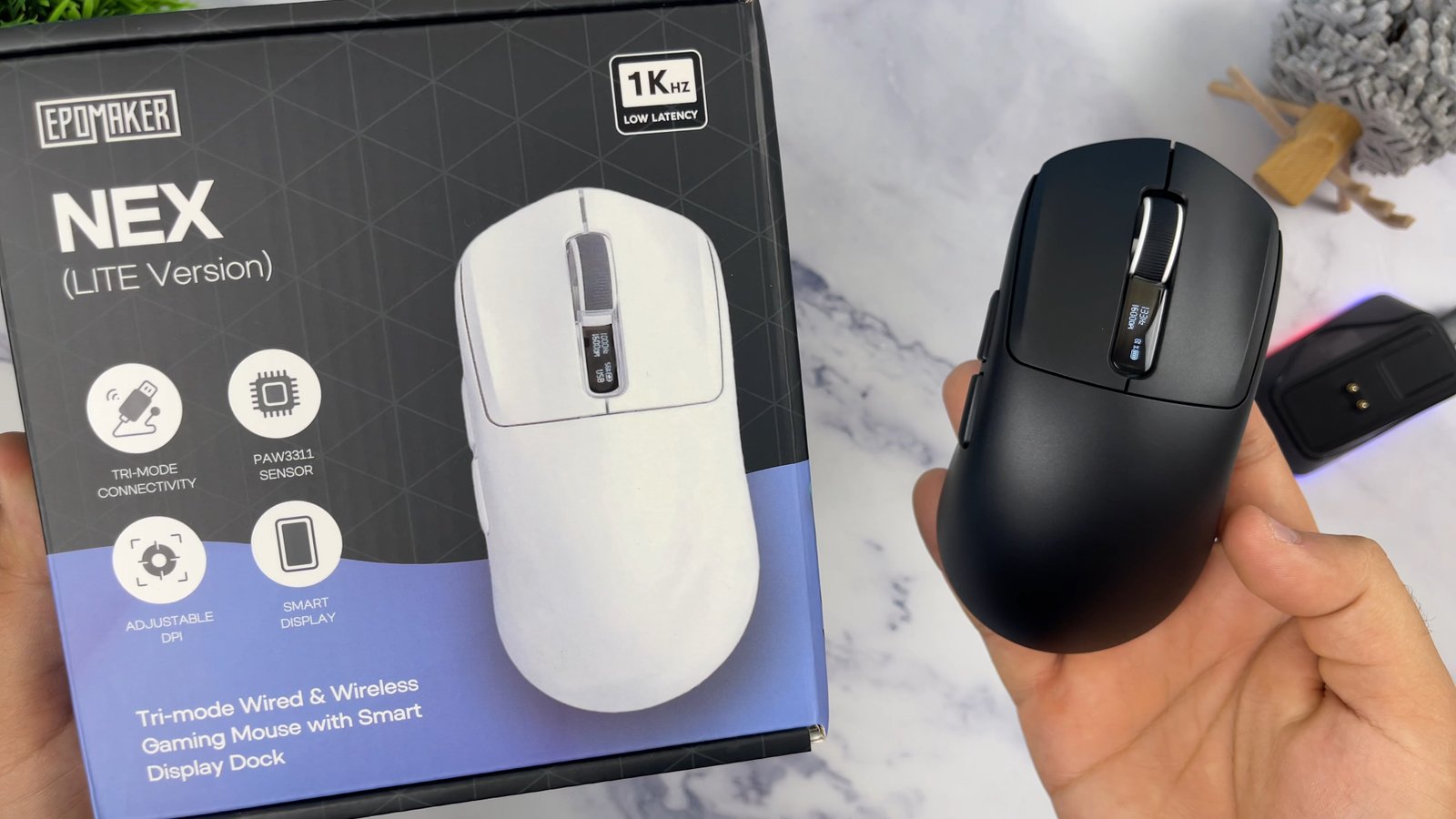
The budget gaming mouse market is currently flooded with ultralight shells, but Epomaker is taking a distinctly feature-first route with the Epomaker Nex Lite. Priced at roughly $32 to $35 on official channels and major retail storefronts, this peripheral aims to bring desktop convenience into an entry-level price bracket.
Rather than stripping away physical hardware to achieve sub-40-gram weights, the Nex Lite focuses on real-world practicality by integrating dual OLED status displays, tri-mode wireless connectivity, and a dedicated magnetic RGB charging dock right out of the box.
Ergonomic Shape and Physical Build
The Epomaker Nex Lite measures 122 x 65 x 42 mm and weighs in at an even 65 grams. Epomaker chose an asymmetrical, right-hand ergonomic layout featuring a subtle lateral tilt rather than an aggressive slant. The rear hump fills the hand comfortably, making it an intuitive fit for medium-to-large hands using a palm or relaxed claw grip. Those with smaller hands or fingertip grips may find the rear profile somewhat pronounced during fast sweeps.
Build quality is solid for an affordable ABS plastic mouse. Squeezing the side walls with moderate to heavy pressure produces no creaking and no flex that could accidentally trigger the side buttons. Epomaker offers the shell in black, white, light blue, and pastel pink finishes. The smooth matte finish can feel slippery under dry hands, making the included precut adhesive grip tapes a necessary addition for extended gaming sessions.

Dual OLED Screens and Magnetic Charging Dock
The defining hardware feature of the Nex Lite is its dual OLED display implementation. The mouse houses a 0.55-inch display on the top shell between the main clicks, while the magnetic charging dock features its own dedicated side display that replicates the same telemetry. Both panels present real-time battery percentage, active DPI stage, polling rate, and connection status without forcing you to open background drivers.
The angled magnetic charging dock eliminates day-to-day battery anxiety. Drawing the mouse within an inch of the cradle snaps it onto the pogo pins with a secure magnetic pull. Underneath the dock, an integrated RGB light ring provides charging feedback and ambient accent lighting. While powering dual OLED screens and RGB consumes battery faster, dropping the mouse into its dedicated cradle after each desk session keeps the 500 mAh cell consistently topped off.

Switch Tactility, Buttons, and Sensor Performance
Under the main buttons, the mechanical switches are rated for 20 million clicks. They actuate with a sharp, tactile break and minimal pre-travel, though the acoustic profile is noticeably loud and slightly hollow compared to high-end optical switches. The scroll wheel offers defined, notched steps suitable for tactical weapon swapping, while the side thumb buttons sit recessed enough to prevent accidental presses despite a slightly spongy bottom-out feel. The dedicated DPI toggle sits underneath the chassis next to the tri-mode switch, requiring you to physically lift the mouse to cycle stages.
Tracking is handled by the PixArt PAW3311 optical sensor. It tracks up to 12,000 DPI across six default steps (400, 800, 1600, 3200, 5600, 12000), running at 300 IPS, 35G acceleration, and a maximum 1,000 Hz polling rate over 2.4 GHz wireless. In routine gaming, target acquisition remains stable with 1 ms latency and no unintended smoothing or spinouts during standard swipes. Ultra-low-sensitivity esports players who execute violent flicks across wide pads will find the limits of the budget sensor, but casual titles and daily productivity track reliably.

Web Driver and Multi-Device Connectivity
Epomaker avoided bloated desktop software by implementing a web-based Chromium configurator. Accessing the utility through Chrome, Edge, or Opera grants access to button remapping, macro creation, custom DPI stages, sleep timers, and RGB dock lighting. All profile modifications write straight to the mouse’s onboard memory, preserving configurations when switching between Windows, macOS, or console setups.
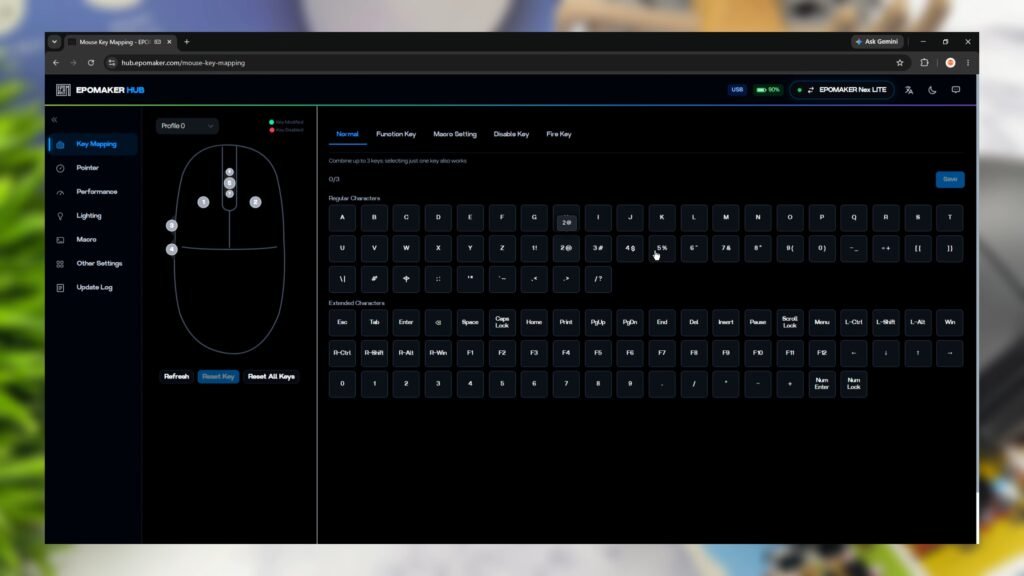
Connectivity options cover standard tri-mode operation via 2.4 GHz wireless, Bluetooth 5.0, and a direct USB-C wired connection. Battery longevity averages around 8 days under regular five-hour daily workloads over 2.4 GHz before reaching the 20% warning threshold. A complete recharge from depleted levels takes roughly three hours when seated on the dock’s pogo pins.
Final Thoughts — Price & Value
The Epomaker Nex Lite delivers an unusual amount of hardware utility for its $32 to $35 retail bracket. While competitive esports purists might miss high-end features like 4K/8K polling rates or a flagship PAW3950 sensor, those components drive up costs without benefiting standard PC routines. The combination of a reliable 1,000 Hz PAW3311 sensor, solid 65-gram ergonomic weight distribution, and zero-install web configuration handles everyday computing and gaming comfortably.
What truly elevates the value proposition is the inclusion of the magnetic charging cradle and dual OLED status screens. Most peripheral manufacturers charge extra for standalone charging bases, yet Epomaker integrates the dock, wireless dongle passthrough, extra skates, and custom grip tapes straight out of the box. Having visible telemetry for battery percentages and DPI eliminates guessing and software background bloat.
