

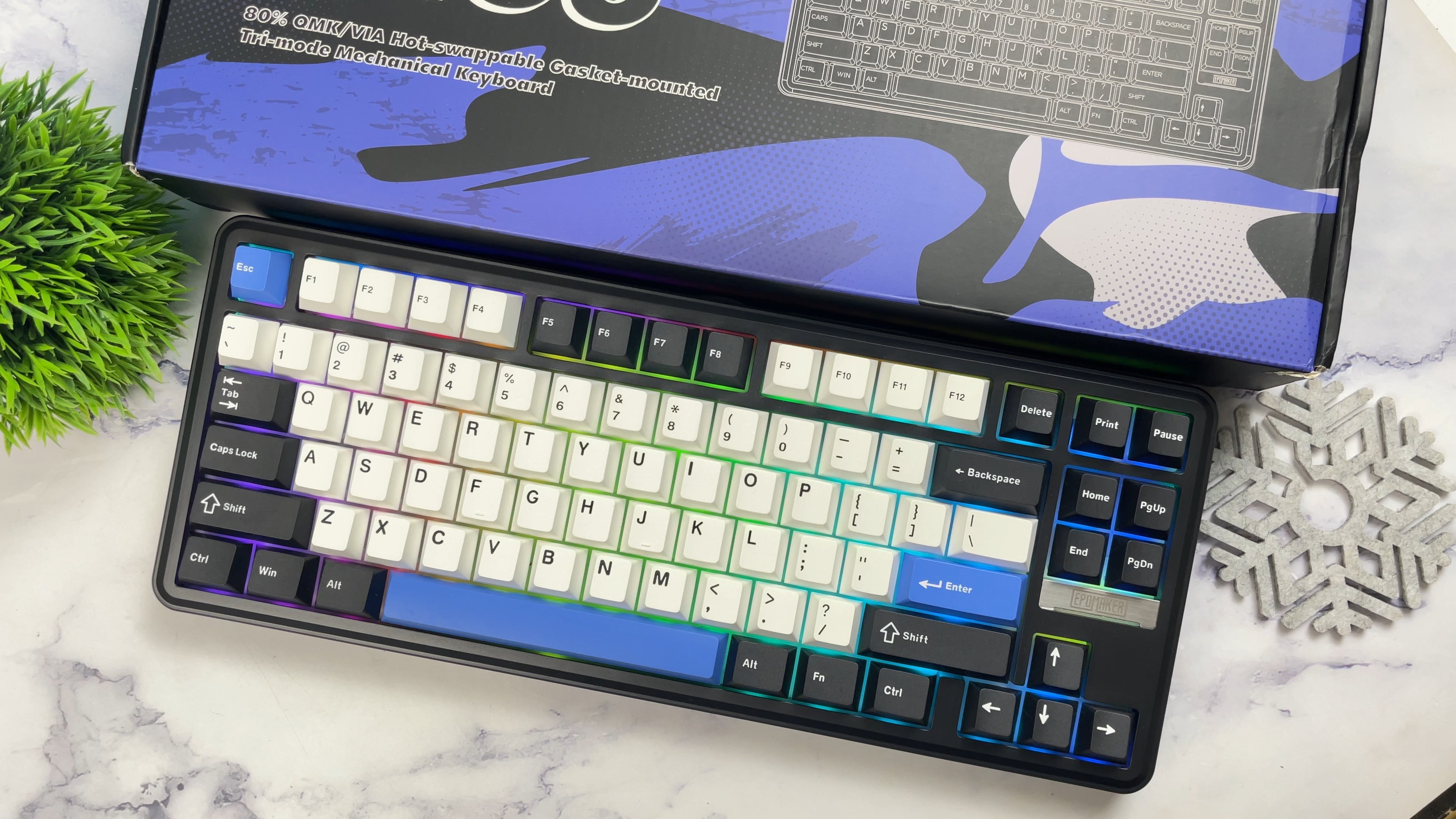
I have spent the last few weeks testing Epomaker’s latest entry into the highly competitive budget mechanical keyboard market: the Epomaker TH85. While it officially retails for an MSRP of $79.99, you can now grab a unit for an incredibly aggressive price of $55.99 on Amazon.
This review is based entirely on my specific model, which features the Black-White-Blue colorway and comes equipped with the linear Creamy Jade switches. At this sub-$60 price point, this keyboard attempts to deliver a premium, enthusiast-level typing experience without breaking the bank, targeting both entry-level mechanical keyboard enthusiasts and casual gamers looking for that deep, marbled acoustic profile out of the box.
Design, Layout & Build Quality
The Epomaker TH85 adopts a true 80% ANSI layout featuring 84 keys, providing a more compact physical footprint than a standard Tenkeyless (TKL) form factor while retaining crucial dedicated keys. It incorporates a full function row, arrow keys, and primary navigation keys like Home, End, Page Up, and Page Down. Unlike many competing 75% layouts that cram navigation keys vertically along the right side, the TH85 spaces them effectively. It omits a physical volume knob in the top-right corner, defaulting instead to Print and Pause keys, though these can be easily remapped via software.
Constructed entirely out of molded ABS plastic, the outer chassis exhibits some structural flex when twisted under deliberate pressure. However, the overall construction feels rugged and composed during typical desk use. The exterior aesthetics are enhanced by curved corners and a distinct sloped design wrapping around the edges. Flip-out feet on the base provide two additional typing angles alongside its flat baseline profile, and a dedicated storage slot for the wireless receiver is hidden underneath the left kickstand.

Acoustics & Internal Construction
The acoustic signature is arguably the standout element of this board, delivering a remarkably deep “thocky” and marble-like sound profile entirely stock. This is achieved through a meticulously layered internal dampening stack. Secured by eight hex screws on the rear rather than a cheaper snap-on casing, the board is highly accessible for aftermarket modifications. Inside, a 1.5mm flexible polycarbonate plate featuring dedicated flex cuts is suspended via a secure wrapper gasket mount design.
Epomaker packed the internal cavity with premium sound-damping materials. This includes a Poron sandwich plate foam, an IXPE switch pad, a Poron switch socket pad, and a thick silicone base pad taking up the entire bottom floor of the ABS shell. This dense assembly eliminates high-pitched typing resonance and hollow vibrations, creating a quiet, muted, yet distinctly tactile auditory response. The stock plate-mounted stabilizers arrive heavily pre-lubed and tuned from the factory, entirely eliminating rattle on the spacebar and modifier keys.

Switches, Keycaps & Performance
My model features the Epomaker Creamy Jade linear switches, which offer an incredibly smooth travel right out of the box. These switches are built with a five-pin hot-swappable architecture and feature a 45g actuation force, a 50g bottom-out force, and a total travel of 3.6mm. They arrive pre-lubed with a fine coating of silicone grease on the internal plungers, ensuring a highly consistent glide without any scratchiness or ping.

The included Cherry-profile keycaps are manufactured using double-shot PBT plastic, ensuring that the legends will never wear off or become shiny over time. The keycap texture provides a comfortable, dry grip that prevents finger slippage during extended typing sessions. For hardware compatibility, a physical toggle on the back switches between Windows and macOS tracking layouts, though Mac users should note that dedicated Command or Option keycaps are not bundled in the box.

Connectivity & Battery Life
The TH85 features comprehensive tri-mode connectivity: wired USB-C, Bluetooth 5.0 (supporting up to three paired devices), and a low-latency 2.4 GHz wireless connection. The polling rate reaches 1000 Hz in both wired and 2.4 GHz wireless modes, dropping to 125 Hz over Bluetooth connections.
Wireless latency tests indicate a swift 2ms delay over a wired connection and a highly responsive 5ms delay using the proprietary wireless dongle. Full N-key rollover is present across all connection modes to ensure no keystrokes are dropped.

Powering the wireless components is an integrated 4,000 mAh rechargeable battery. Due to the sheer brightness and volume of the onboard RGB lighting zones, power consumption varies wildly depending on your configuration.
With the RGB lighting array fully active under heavy usage, the battery drains in approximately 2 to 3 days. Deactivating the lighting array extends the battery life to anywhere between 5 and 14 days on a single charge. Users can check the current battery percentage at any time by pressing Function + Enter, which lights up the number row from 1 to 0.

RGB Customization & VIA Software
The illumination on the TH85 is exceptionally vibrant, powered by south-facing RGB LEDs mounted on a 1mm thick PCB. The underglow features 46 distinct lighting effects cycled via Function + Backspace. Beyond standard per-key backlighting, the board integrates a mesh-covered RGB light strip wrapped around the rear edge and sides, alongside an individually illuminated Epomaker logo badge on the side profile. These accents can be toggled through 10 lighting schemes independently using onboard key combinations. Color saturation and animation speed can also be adjusted directly from the hardware.

Advanced customization relies completely on open-source QMK/VIA software compatibility rather than proprietary bloatware. Users must download the specific TH85 JSON file from the official Epomaker website and load it into VIA to unlock configuration options. The software allows complete per-key remapping across multiple layers, full macro recording with precise delay settings, and individual control over the three separate lighting segments.

Final Thoughts — Price & Value
At the $55.99 price point I paid, the Epomaker TH85 with Creamy Jade linear switches stands out as an unparalleled value proposition within the mechanical keyboard market. While an experienced hobbyist could potentially source a polycarbonate plate, custom gasket mounts, tri-mode wireless PCBs, and aftermarket dampening foams to build a matching keyboard, doing so requires time, patience, and technical knowledge that many buyers lack. This pre-built package completely eliminates that barrier to entry at a fraction of the cost.
The structural ABS plastic shell does flex under heavy twisting, but it remains perfectly rigid during real-world typing and gaming workloads. Its massive 4,000 mAh battery could offer better longevity if the ultra-bright RGB lighting elements were less power-hungry, but running the board with minimal or deactivated backlighting easily mitigates this issue. The low-latency 2.4 GHz wireless connection makes it a very capable option for casual and semi-competitive gaming.
For users looking to enter the mechanical keyboard space without spending over $100, the TH85 delivers premium typing comfort, advanced VIA software customization, and an incredibly satisfying acoustic profile straight out of the box. It easily matches the acoustic refinement of custom keyboards that cost two to three times its price, making it a highly recommended choice for your desktop setup.
