

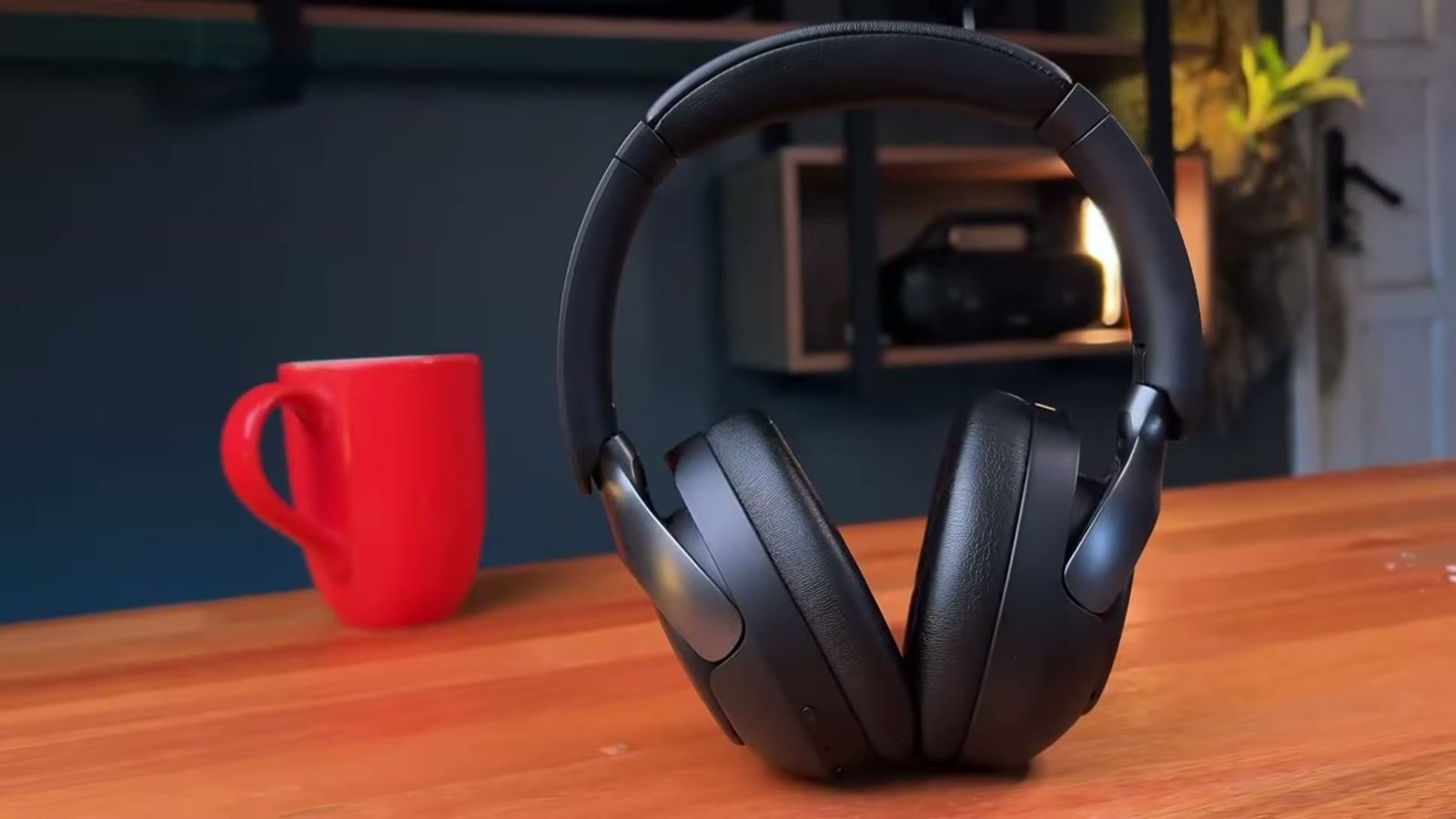
Choosing between the QCY H3 Pro, QCY H3s, and QCY H6 Neo comes down to picking the right balance of noise cancellation, driver architecture, and battery endurance under $65. All three budget over-ear models support LDAC Hi-Res wireless audio and multipoint pairing, with street pricing starting around $40 on AliExpress and Amazon. Small generational upgrades separate them in meaningful ways once you look past the similar matte silhouettes.
I compared all three headphones side by side across build ergonomics, internal acoustic hardware, active noise cancellation, microphone pickup, and companion app EQ behavior. Testing these models back-to-back quickly reveals which one delivers the strongest value per dollar and where each sibling carves out a niche. Here is how the QCY H3 Pro, H3s, and H6 Neo stack up in real-world use.
QCY H3s
The Good (Pros)
- Dual-driver setup (40mm + 13mm tweeter) delivers cleaner highs
- Class-leading -56dB adaptive hybrid ANC with 7 mics
- Up to 102 hours battery life (58 hours with ANC on)
- Bluetooth 6.0 with multipoint and LDAC Hi-Res support
- IPX5 water resistance and 10-minute fast charge
The Bad (Cons)
- Plastic earcup shells feel utilitarian next to pricier rivals
- Default tuning leans warm before EQ adjustment
- Carry case is not included in standard bundles
Quick Navigation (Table of Contents)
- QCY H3 Pro vs H3s vs H6 Neo Specifications
- Design, Comfort & Earcup Ergonomics
- Headband Reinforcement & Mechanical Durability
- Dual-Driver Acoustics vs Single 40mm Drivers
- Active Noise Cancellation & Call Microphone Quality
- QCY App EQ Tuning, LDAC & Spatial Modes
- Battery Endurance & Earpad Comfort Over Long Sessions
- Final Thoughts — Price & Value
- Frequently Asked Questions
QCY H3 Pro vs H3s vs H6 Neo Specifications
| Feature | QCY H3 Pro | QCY H3s (Winner) | QCY H6 Neo |
|---|---|---|---|
| Driver Setup | 40mm Dynamic | 40mm Woofer + 13mm Tweeter | 40mm GrapheneCore Dynamic |
| Hybrid ANC Depth | Up to -50dB | Up to -56dB (7 Mics) | Up to -52dB PureSilenz (5 Mics) |
| Bluetooth Version | Bluetooth 5.4 | Bluetooth 6.0 | Bluetooth 6.0 |
| Hi-Res & Codecs | LDAC, AAC, SBC | LDAC, AAC, SBC | LDAC, AAC, SBC + USB-C Audio |
| Battery (ANC ON) | ~40 Hours (550mAh) | ~58 Hours (750mAh) | ~61 Hours (750mAh) |
| Battery (ANC OFF) | ~55–60 Hours | ~102 Hours | ~96 Hours |
| Weight & Protection | ~231g | ~240g (IPX5 Rated) | ~245g |
| Typical Street Price | $40 – $48 | $42 – $55 | $50 – $65 |
Design, Comfort & Earcup Ergonomics
All three QCY models follow a clean, understated matte aesthetic with foldable hinges and soft protein-leather earpads. At roughly 231g, the QCY H3 Pro sits lightest on the head, while the H3s (240g) and QCY H6 Neo (245g) carry slightly larger 750mAh battery cells. I found clamping force balanced across all three pairs, allowing multi-hour desk sessions without painful hotspot pressure around the ears.
The H3s adds an IPX5 water-resistance rating that neither the H3 Pro nor H6 Neo advertises, making it safer for humid commutes or light rain. Deep internal earpad cavities with clear left and right mesh indicators keep your ears from pressing directly against the driver housing. Comfort differences are subtle, so build durability and weather protection tilt slightly toward the H3s.

Headband Reinforcement & Mechanical Durability
Budget headphones often fail at the headband adjustment track, so I inspected the metal reinforcement sliders across the lineup. Extending the earcups reveals a brushed steel inner band that clicks firmly into place without wobbling or rattling. On the QCY H6 Neo, the outer yoke transitions smoothly into the slider, giving it a slightly cleaner modern profile than the older H3 Pro.
Physical button placement along the right earcup remains intuitive across every model, letting you toggle ANC modes, adjust volume, and skip tracks by feel alone. I prefer tactile buttons over finicky capacitive touch panels, especially when adjusting playback with gloves or while walking. Folding all three models inward lets them slip easily into a backpack sleeve.

Dual-Driver Acoustics vs Single 40mm Drivers
Under the earpads, acoustic engineering is where the QCY H3s pulls decisively ahead of its siblings. Opening the acoustic chamber exposes a coaxial dual-driver array pairing a 40mm dynamic woofer with a dedicated 13mm tweeter. Separating low-end punch from upper-mid and treble detail gives vocals and cymbals noticeably cleaner separation than the single 40mm driver inside the H3 Pro.
Meanwhile, the QCY H6 Neo relies on a single 40mm GrapheneCore dynamic driver tuned for energetic bass impact and spatial width. It also includes native USB-C wired audio support, allowing lossless digital playback directly from a laptop or phone without battery drain. Listeners who prioritize crisp instrument separation will prefer the H3s, while fans of wired USB-C DAC convenience will appreciate the H6 Neo.

Active Noise Cancellation & Call Microphone Quality
Noise cancellation has improved steadily with each generation, moving from -50dB on the H3 Pro to -52dB PureSilenz ANC on the H6 Neo and peaking at -56dB on the H3s. Powered by a seven-microphone array, the QCY H3s cuts deeper into low-frequency bus rumble and air-conditioning hum than its siblings. Transparency mode also sounds more natural on the H3s and H6 Neo, letting quick conversations pass through without harsh digital hiss.
For voice calls, the H3s and H6 Neo both leverage AI noise reduction to isolate speech in windy outdoor environments. I tested call clarity outdoors and found the H3s's extra microphones kept my voice slightly cleaner against traffic noise than the H3 Pro. All three support multipoint Bluetooth connections, with the H3s and H6 Neo stepping up to Bluetooth 6.0 for rock-solid link stability.

QCY App EQ Tuning, LDAC & Spatial Modes
Connecting any of these three headphones to the QCY mobile app unlocks custom 10-band EQ presets, ANC intensity sliders, and firmware updates. Out of the box, QCY's default tuning emphasizes warm sub-bass, which I dialed back slightly in the app to let the H3s tweeter shine. Enabling LDAC requires toggling high-resolution mode in the app, which pairs smoothly with Android devices for 990kbps streaming.
Spatial audio modes are available on all three models, adding wider virtual staging for movies and casual YouTube watching. I still recommend keeping spatial processing off for critical music listening so stereo imaging stays accurate and punchy. Having full app EQ control across a sub-$55 headphone lineup adds real longevity to the listening experience.

Battery Endurance & Earpad Comfort Over Long Sessions
Battery capacity is the biggest practical divider between the older H3 Pro and the newer 750mAh siblings. While the H3 Pro delivers a respectable 40 hours with ANC active (up to 55 hours off), the QCY H3s stretches endurance to 58 hours with ANC on and an astonishing 102 hours with ANC off. The QCY H6 Neo lands nearly neck-and-neck at 61 hours with ANC on and 96 hours without it.
Fast charging via USB-C gives the H3s roughly seven hours of playback from a quick ten-minute top-up before heading out the door. Plush memory-foam earpads seal securely around glasses frames without breaking the ANC seal or causing ear fatigue. For multi-day trips without a charger, the H3s and H6 Neo outlast the H3 Pro by a wide margin.

💡 Recommended Alternatives: Compare these QCY models against other budget champions in our TOZO HT3 Review, our OneOdio Fusion A70 Gen 2 Review, and browse the full Headphones Hub.

QCY H3s Dual-Driver ANC Headphones
- 40mm + 13mm Dual Drivers
- -56dB Adaptive Hybrid ANC
- Bluetooth 6.0 & LDAC
- 102h Battery (58h ANC On)
- 7-Mic Call Clarity
Final Thoughts — Price & Value
Between these three QCY budget contenders, the QCY H3s delivers the strongest overall hardware package for around $45. Its dual-driver architecture, -56dB hybrid ANC, Bluetooth 6.0, IPX5 rating, and 102-hour battery life easily outclass the older H3 Pro for nearly the same street price. Meanwhile, the QCY H6 Neo justifies its slightly higher $55–$65 tag only if you specifically need USB-C wired digital audio.
Buy the QCY H3s on AliExpress or Amazon if you want the best mix of ANC power, sound clarity, and battery endurance under $50. Its dual-driver acoustic chamber and 102-hour runtime easily justify the modest step up from older budget models. Choose the QCY H6 Neo if wired USB-C laptop listening is essential, and only pick the QCY H3 Pro when a deep clearance sale drops it well below $35.
Frequently Asked Questions
Which has better sound quality: QCY H3 Pro, H3s, or H6 Neo?
The QCY H3s offers the cleanest overall sound quality thanks to its dual-driver setup pairing a 40mm woofer with a 13mm tweeter. That extra tweeter gives vocals and treble noticeably better separation than the single-driver H3 Pro. The H6 Neo counters with punchy GrapheneCore bass and lossless USB-C wired audio support.
Which QCY headphone has the strongest ANC?
The QCY H3s leads the trio with adaptive hybrid ANC rated up to -56dB using a seven-microphone array. The QCY H6 Neo follows closely at -52dB with PureSilenz processing, while the older H3 Pro tops out at -50dB. All three handle commuter drone well, with the H3s edging ahead on deeper low-end rumble.
Do the QCY H3s and H6 Neo support LDAC and Bluetooth 6.0?
Yes, both the QCY H3s and QCY H6 Neo ship with Bluetooth 6.0, multipoint dual-device pairing, and LDAC Hi-Res wireless support. The older QCY H3 Pro also supports LDAC and multipoint pairing, though it runs on Bluetooth 5.4. You can enable LDAC inside the QCY companion app on Android.
Is the QCY H3 Pro still worth buying over the H3s?
At normal retail prices around $40 to $48, the QCY H3s is a far better buy because it doubles battery life and upgrades both drivers and ANC for a few dollars more. The QCY H3 Pro only makes sense if you catch a steep discount under $35 or strongly prefer its slightly lighter 231g frame. Otherwise, the H3s wins every major category.
