

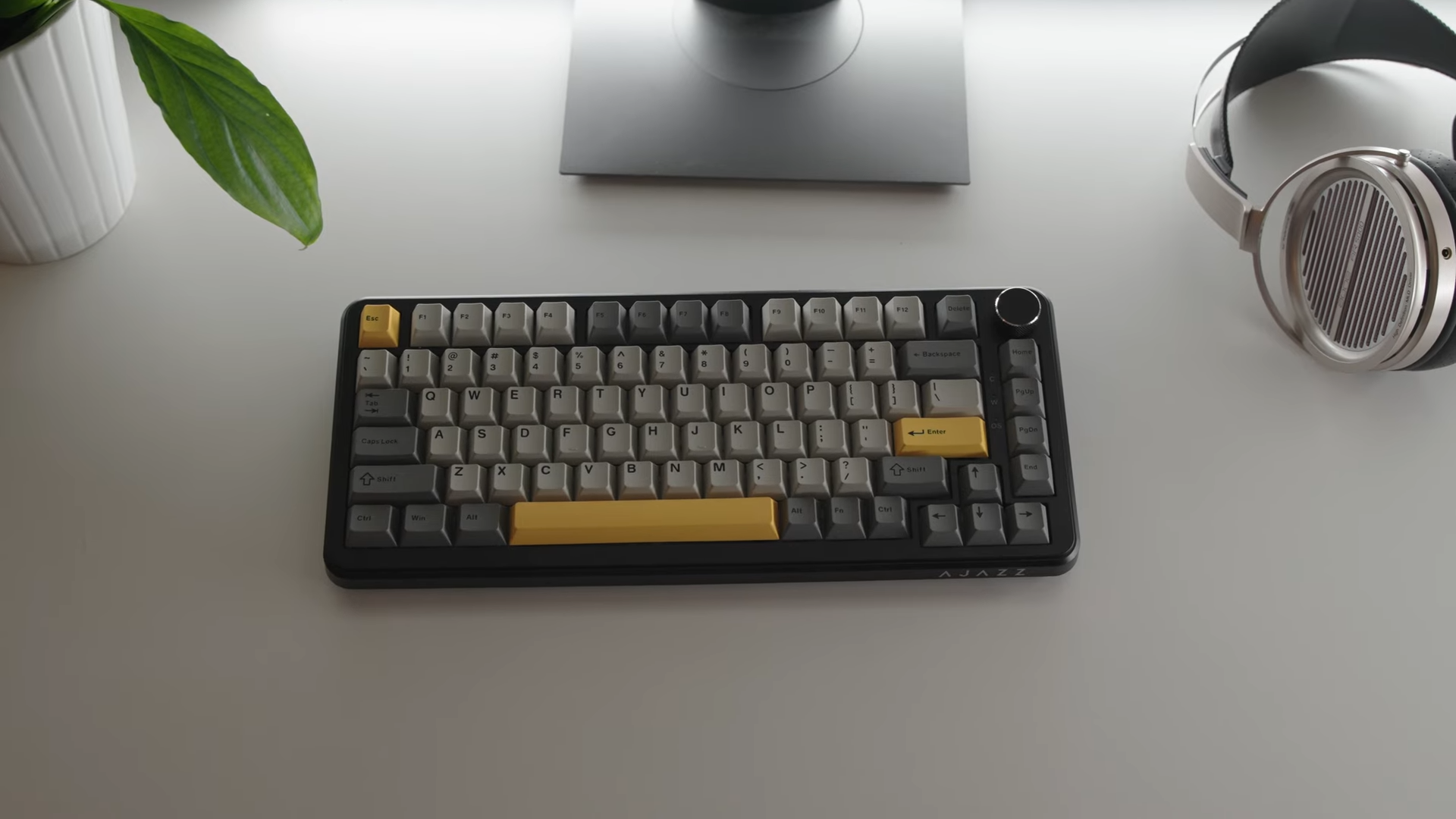
I have spent years testing gaming peripherals, tracking the evolution of rapid trigger technology from premium luxury to budget-friendly accessibility. Today, my focus shifts to the Ajazz AK820 HE, a magnetic switch keyboard that promises high-end performance at an incredibly low price point. Retailing at a sub-$60 price tag, tax included, this device aims to disrupt the market by offering rapid trigger mechanics without the premium cost.
Finding a high-polling-rate magnetic keyboard at this price point raises immediate questions about build quality and switch calibration. I put this keyboard through a series of rigorous objective tests to determine if it truly competes with market giants or falls short due to budget cuts.

Design, Aesthetics, and Unboxing Experience
Unboxing the device reveals a distinct aesthetic choice that immediately sets it apart from traditional sleek black keyboards. I tested the gray and yellow colorway, which features striking yellow accents that strongly evoke a cyberpunk-inspired design language. The packaging also includes a standard non-braided USB-C cable alongside a combination keycap and switch puller for maintenance.
The keyboard utilizes a compact 75% layout, retaining essential navigation keys while saving valuable desk space for mouse movements. A dedicated physical knob sits in the top right corner, offering tactile control over volume and system settings. One notable design eccentricity is the placement of the USB-C port on the right side of the chassis, which might complicate cable management for users who prefer custom coiled cables.

Build Quality and Gasket-Mounted Acoustics
The external housing consists entirely of plastic, which feels expected for a budget-oriented device under seventy dollars. To balance this, the internal structural key plate is constructed from aluminum, adding a reassuring rigidity and bringing the total weight to 860 grams. Sound-dampening materials are heavily featured inside, including Poron foam, EVA plate foam, and a custom silicone case pad.

Typing feels stable due to pre-lubed, plate-mounted stabilizers that minimize rattle across larger keycaps. The keycaps themselves are made of double-shot PBT with non-transparent legends, which enhances durability over long gaming sessions. Illumination is handled by bright, south-facing RGB LEDs positioned to prevent direct glare from shining into your eyes while playing.
The pre-lubed magnetic switches feel a tad scratchy during slower, regular typing tasks. Despite this minor friction, the keys still deliver a far better typing sensation than the stock switches found on much more expensive competitors from brands like Razer or SteelSeries. My sound tests confirm a surprisingly deep, satisfying acoustic profile that benefits immensely from the multi-layered gasket mount system.

Latency Testing and Gaming Performance
Performance is the core metric for any rapid trigger keyboard, and this device does not disappoint in raw speed. I measured an impressive average response time of 24.1 milliseconds during my standardized gaming latency benchmarks. This speed positions the device remarkably close to the industry-leading Wooting 60HE and only slightly behind the newer Wooting 80HE.

My testing methodology relies on a high-speed Sony RX 107 camera recording at 1000 frames per second to capture frame-by-frame inputs. I paired this camera with an MSI 4K 240Hz OLED monitor to display OverWatch 2 gameplay. By measuring the exact time elapsed between physical button release and the corresponding on-screen action across ten separate test runs, I ensured highly accurate latency data.
An input discrepancy of only four milliseconds compared to top-tier keyboards is virtually imperceptible in real-world competitive scenarios. The internal hardware fully supports a true 8000 Hz polling rate, which I kept active throughout all my testing procedures. Gamers seeking instantaneous response times will find the raw electrical performance of this budget option outstanding.

Rapid Trigger Calibration and Sensitivity Workarounds
Achieving perfect calibration is where many budget magnetic keyboards struggle, and this device encounters similar hurdles. Setting the rapid trigger sensitivity to the ultra-low 0.1 mm threshold leads to highly unstable behavior, resulting in random key activations and deactivations. This erratic performance stems from poor factory calibration that cannot be easily fixed by recalibrating through the software.
Resolving this frustrating issue requires a simple, manual adjustment to the sensitivity thresholds within the configuration software. Setting the rapid trigger activation point to 0.2 mm or 0.3 mm completely eliminates the phantom key presses and restores perfect input stability. At a software setting of 0.3 mm, the switches actually actuate at around 0.2 mm, confirming that the physical sensors require slightly higher tolerances to function reliably.

Future firmware updates could potentially resolve these underlying calibration flaws and unlock more precise tracking at lower thresholds. Buyers must decide if adjusting their settings to a slightly less sensitive threshold is an acceptable compromise for a budget-friendly device. For most competitive players, a stable 0.3 mm rapid trigger remains exceptionally fast and perfectly usable for fast-paced gaming.
Software Customization and Reset Quirks
The configuration utility functions well enough to adjust essential settings, though the interface resembles a generic reskin of typical budget keyboard programs. The visual design and general user experience lack the polish seen in premium software suites. Despite these cosmetic shortcomings, the program allows for extensive key remapping, RGB profile creation, dynamic keystroke assignments, and actuation distance tuning.
One particularly annoying software bug occurs when you close the application completely. The program regularly forgets customized user settings upon exit, reverting the keyboard back to its default configurations. Keeping the software open in the background or saving profiles directly to onboard memory is necessary to bypass this frustrating software behavior.

Final Thoughts — Price & Value
The Ajazz AK820 HE represents a highly compelling option for gamers seeking rapid trigger advantages on a strict budget. While the minor calibration issues at 0.1 mm and the quirky software suite present clear drawbacks, the structural build quality and remarkable 24.1 ms response time make it a serious contender. Compromises are inevitable at a sub-$60 price point, yet the vital performance metrics remain incredibly strong.
Buyers who can tolerate setting their rapid trigger to 0.3 mm will find immense value in this gasket-mounted keyboard. It easily outclasses many older mechanical boards and holds its own against premium models costing more than double. I highly recommend this device as a cost-effective gateway into the world of high-speed magnetic switch keyboards.
