

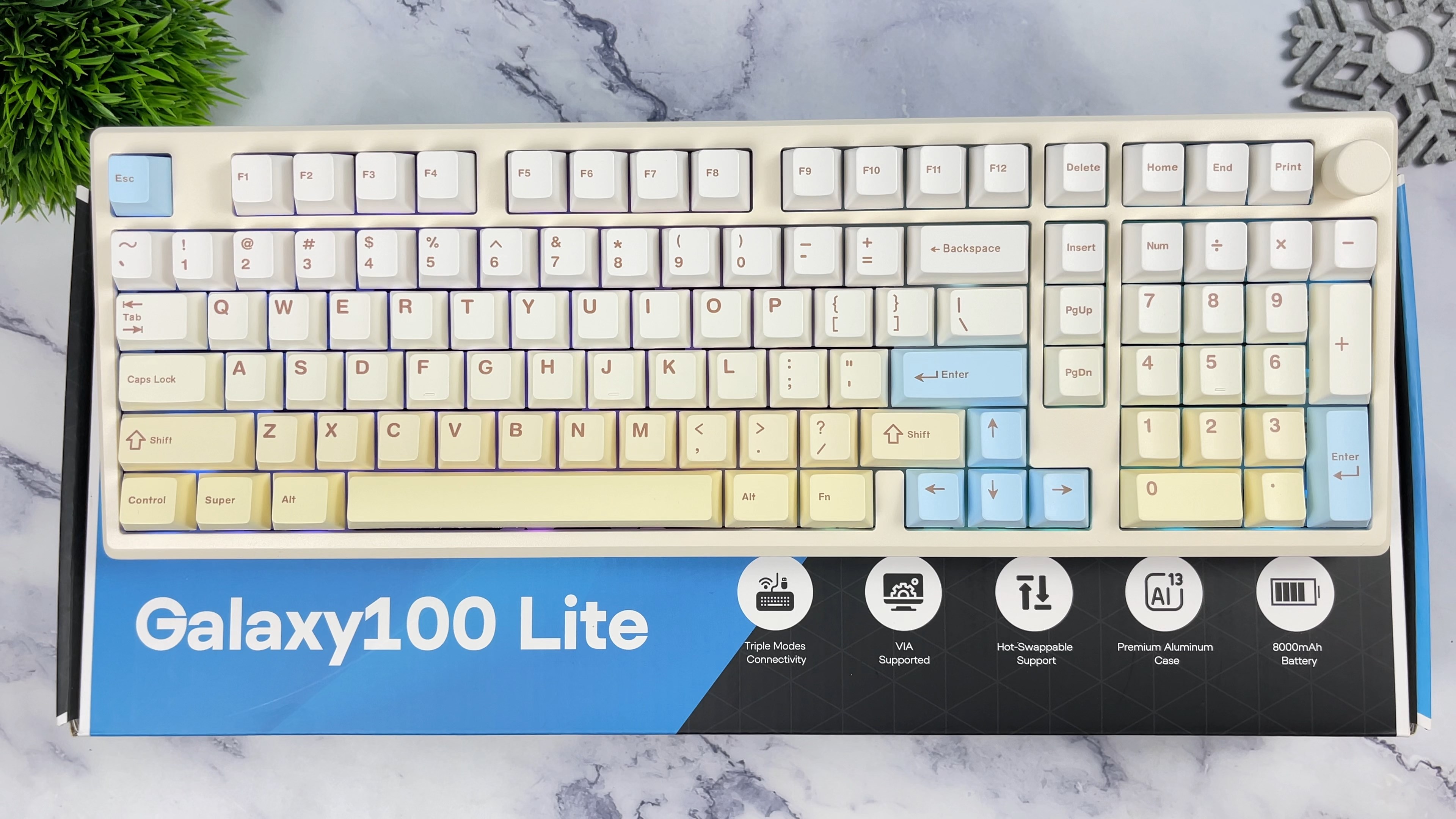
The quest for a high-quality, full-sized mechanical keyboard that does not obliterate your budget has historically led to frustrating compromises. Most affordable options rely heavily on plastic frames, generic switches, and subpar acoustics.
Epomaker intends to disrupt this segment with the Epomaker Galaxy100 Lite, a 96% layout mechanical keyboard featuring a full aluminum chassis, triple-mode connectivity, and a dedicated volume knob. Sitting comfortably around the $93 to $102 mark, depending on the switch configuration, this heavy mechanical option presents an entry point into premium desk aesthetics without the traditional financial barrier.
I examined this keyboard to determine whether the “Lite” branding implies stripped-back performance or represents a streamlined, highly functional design. By analyzing its internal construction, physical layout, acoustic properties, and software integration, this evaluation details exactly what you receive for your money.
Mechanical Layout and Sturdy Frame Construction
The Epomaker Galaxy100 Lite utilizes a 96% (1800-compact) layout encompassing 100 keys alongside a tactile volume knob situated in the upper right-hand corner. Despite the “Lite” moniker, the device is built entirely upon a dense aluminum base. This provides a premium weight of roughly 1.66 to 1.7 kilograms. This heavy profile anchors the chassis firmly to the desk surface. It effectively eliminates structural flex during rapid typing or intense gaming sessions.

The external aesthetics differ across its color options: the black variant provides a traditional aesthetic, while the off-white or cream option leans toward an eggshell or “cupcake” aesthetic.
Looking at the physical connectivity layout, the back of the case features a dedicated hardware toggle to switch seamlessly between connection modes. It also features a centrally positioned USB Type-C port.

The base is cast at a fixed typing angle supported by thick rubber feet. It excludes adjustable flip-out feet. On the underside of the aluminum case, Epomaker integrated a polished, glass-like accent mirror plate to distinguish its styling from generic budget entries. One notable layout omission is an integrated storage slot within the metal housing for the 2.4 GHz wireless dongle. Instead, the dongle ships clipped into a storage holder attached directly to the included 1.8-meter braided USB cable.

Acoustic Profile and Complex Internal Layers
Internally, the Galaxy 100 Lite is built around a gasket-mounted assembly paired with a 1.2 mm flex-cut polycarbonate (PC) plate and a matching 1.2 mm flex-cut PCB. Despite the extensive flex cuts across both the plate and circuit board, the overall typing feel remains relatively stiff rather than overly bouncy.
The acoustic signature leans directly into a deep, satisfying “thocky” and slightly creamy sound profile right out of the box. This relies on a structural dampening system composed of inter-plate PORON foam, an IXPE switch sheet, and a bottom static sheet. However, disassembling the board via its six standard Phillips screws reveals that the absolute bottom of the aluminum case is quite sparse on heavy foam filling. This minimal case dampening can introduce a slight, audible metallic ping when typing forcefully or striking the edges.

The pre-lubed, plate-mounted stabilizers perform exceptionally well for a stock budget keyboard. They provide crisp, rattle-free performance on the larger modifier keys. For users who prefer an even quieter or more acoustic-focused experience, the keyboard responds beautifully to simple modifications. Applying a two-layer painter’s tape mod to the back of the PCB eliminates the open case echo. Adding a single strip of tape inside the cavity of the spacebar helps dampen the hollow, sharp pinging associated with long PBT spacebar caps.
Switch Performance and Everyday Typing Comfort
The keyboard is offered with multiple switch variants, notably including the Epomaker Wisteria Linear V2 switches. These updated linear switches are equipped with an integrated light diffuser designed to evenly scatter the keyboard’s south-facing RGB illumination. The Wisteria V2 switches are light, remarkably smooth, and exhibit minimal stem wobble when pressed off-center. This makes them highly forgiving for extended typing sessions and fast office productivity.

The stock keycaps are premium, non-shine-through, double-shot PBT caps molded in a classic Cherry profile. This delivers a lower, comfortable typing height compared to the taller MDA profile keycaps found on the standard Galaxy 100.
For daily office use, the noise level ranges from an ambient 44 decibels up to approximately 75 decibels under intense typing. Average typing hovers around 60 decibels. This is roughly equivalent to standard office chatter or background noise. It provides clear auditory feedback without being loud enough to disturb coworkers or bleed aggressively into nearby microphones during calls.

The inclusion of a dedicated number pad makes data entry seamless. Meanwhile, the aluminum volume knob provides distinct, tactile steps when rotated to give precise audio adjustments. However, the knob stem exhibits a small amount of physical wobble or rattle when manipulated.
Triple-Mode Connectivity and Real-World Latency
The Galaxy 100 Lite features tri-mode connectivity, supporting wired USB-C, 2.4 GHz wireless, and Bluetooth 5.0. Wired and 2.4 GHz wireless modes operate at a fast 1000 Hz polling rate. This provides responsive inputs during competitive gaming sessions. Bluetooth mode drops to a standard 125 Hz polling rate to conserve power.
While the physical connection hardware is robust, the real-world Bluetooth wake-up latency is a notable drawback. When the keyboard enters its automatic sleep mode to save energy, waking it via a Bluetooth connection can introduce an annoying delay of up to 10 seconds before the keyboard reconnects and registers keystrokes. This behavior occurs across both Windows and macOS systems. It can disrupt workflows if you type rapidly after a period of inactivity. Consequently, users who require immediate responsiveness are better off utilizing the 2.4 GHz wireless dongle or keeping the keyboard wired.

Dynamic RGB Illumination and VIA Customization
The south-facing LED layout provides smooth backlighting that glows around the base of the keys. Because the double-shot PBT caps lack transparent legends, the RGB effects function primarily as ambient backlighting rather than illuminating the letters in pitch-black rooms.
The LEDs offer vivid color reproduction that remains clearly visible in daylight. However, the firmware omits a true, neutral white light mode. Selecting white within the software produces a distinctly pale, light-blue hue.

Unlike many budget keyboards that rely on clunky, outdated software utilities, the Galaxy 100 Lite fully supports open-source QMK and VIA customization. By downloading the correct model JSON file from the Epomaker website and importing it into the VIA interface, you unlock complete control over the layout.
VIA lets you remap any key, configure multi-character macros, manage layered function maps, and customize the rotating knob’s function or button click. These custom settings save directly onto the keyboard’s onboard memory, maintaining your configuration across different computers without needing background software.

Final Thoughts — Price & Value
The Epomaker Galaxy 100 Lite offers a compelling value proposition, shifting the entry point for full-aluminum mechanical keyboards down close to the $100 mark. Competing options with similar 96% or full-sized layouts frequently utilize plastic housings or demand a steep premium. By combining a hefty 1.7 kg aluminum case with excellent stock stabilizers, smooth factory-lubed Wisteria V2 linear switches, and out-of-the-box VIA customization, Epomaker delivers premium enthusiast features at a mainstream price point.
The keyboard is not without its flaws, as the noticeable wake-up delay on Bluetooth connections represents a clear point of frustration for multi-device wireless workflows. Additionally, the sparse internal case dampening creates a slight metallic ping that requires simple aftermarket tape modifications to fully resolve. For users who intend to run the board via its 1000 Hz wired or 2.4 GHz wireless connections, these wireless sleep bugs become entirely irrelevant to daily operation.
Equipped with a massive 8,000 mAh dual-battery array, the keyboard easily delivers weeks of continuous use even with the ambient lighting active. If you require an integrated number pad for work, appreciate a deep and thocky sound profile, and want the premium look and feel of a heavy metal keyboard without spending hundreds of dollars, the Galaxy 100 Lite stands out as an exceptional budget choice.
