

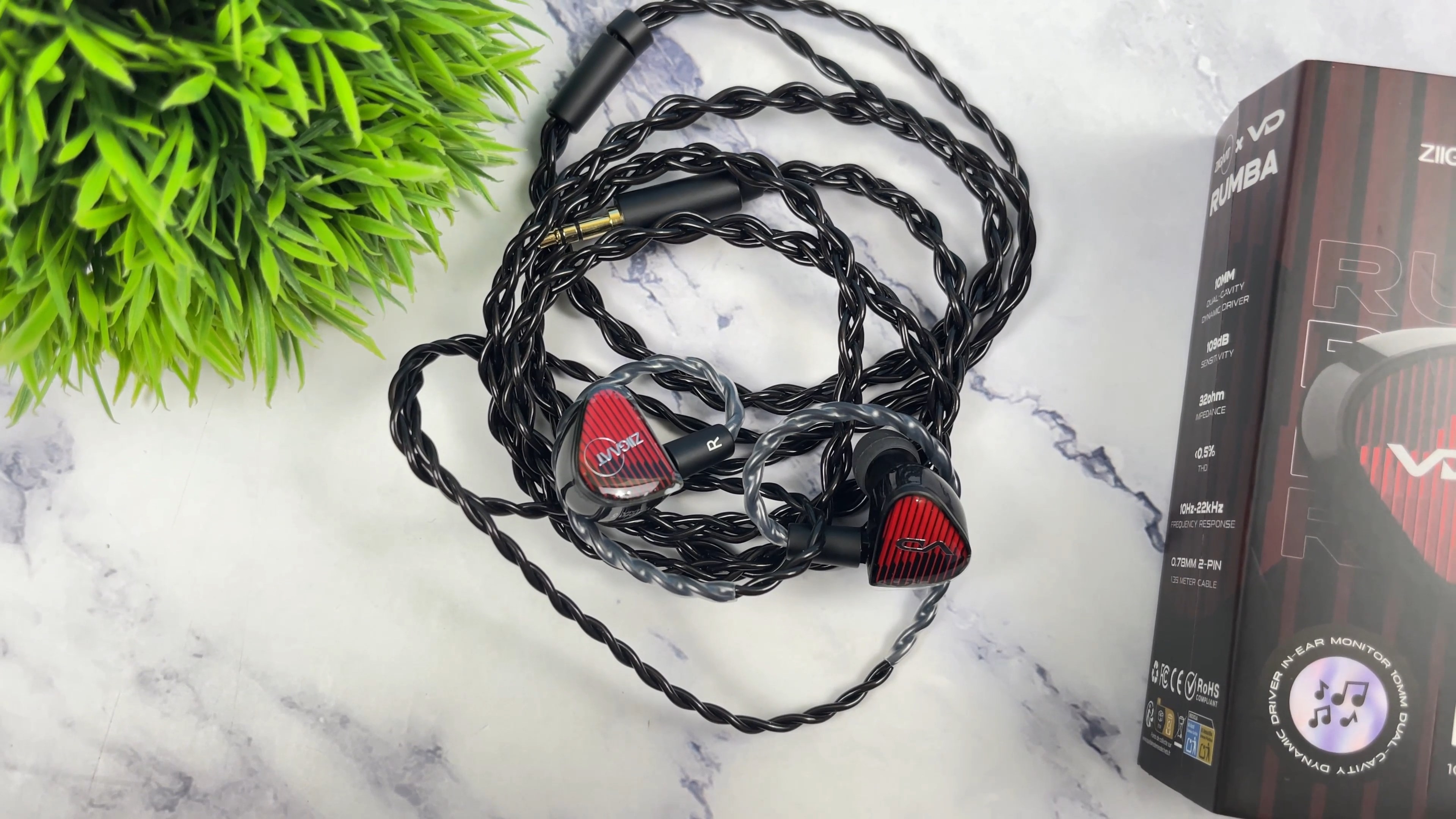
The budget in-ear monitor market is fiercely competitive, but the collaboration between ZiiGaat and Mexican reviewer Roys from Vivir Digital brings something distinct. Priced at $34.99 USD on Linsoul, the Rumba aims squarely at listeners who crave an energetic, bass-heavy presentation without sacrificing the fundamental clarity required for a true high-fidelity experience.
Driven by a single 10 mm graphene dynamic driver housed in a dual-cavity acoustic structure, this resin-shell IEM targets a musical, V-shaped signature. It avoids the common trap of cheap, muddy bass-cannons by utilizing a fast-decaying diaphragm that balances sheer physical slam with surprisingly competent instrument layering.
Design and Packaging
The visual design of the Rumba is heavily influenced by Latin American kinetic art, drawing structural inspiration from the iconic Venezuelan kinetic artist Carlos Cruz-Diez. Created by graphic designer Ani Valbuena, the design links the physical concept of audio frequency to visual frequency. The faceplates rely on alternating black and high-contrast red lines to simulate an optical “ocular vibration” when handled.
The intense red was explicitly chosen to represent the passion, vitality, and heart of Latin American culture. This design extends natively into the retail packaging, where the dark background art is paneled so users can unpack and assemble the structural graphics into a cohesive art display.

The 5.9 mm nozzle diameter is highly ergonomic for small to medium ears, creating an easy, low-fatigue seal that remains comfortable during marathon listening sessions.
The retail packaging includes a distinctive greeting card featuring a custom QR code directing users to official Spotify and Tidal playlists curated by Roys. Rather than a demonstration tracklist designed purely for analytical tech performance, the collection contains upbeat 80s, 90s, and 2000s Latin pop tracks curated to mimic the experience of driving to a festive party or “rumba.”

The retail package is minimal, focusing its budget on the physical earphone and the stock cable rather than luxury packaging. The internal accessory assortment features two distinct styles of silicone eartips shipped in small, medium, and large sizing, designed to preserve the signature tuning.
The stock 4-core silver-plated copper cable is custom-lengthened to 1.35 meters—roughly 15 centimeters longer than typical industry-standard configurations—to afford additional slack when lounging or driving desktop amplifiers. Consumers can choose between a standard 3.5mm option ($34.99 USD) or a variant featuring an inline call microphone ($35.99 USD). However, the omission of a carrying pouch or protective storage case remains a notable missed opportunity.

Sound Quality Analysis
The low end is the undeniable centerpiece of the Rumba. The choice of a dual-cavity graphene-coated driver pays massive dividends here, delivering exceptional sub-bass extension and a heavy mid-bass punch. Tracks like Geordie Greep’s “Bongo Season” display excellent transient speed; the physical impact of the drum kicks is visceral, yet the natural, rapid decay keeps the lower frequencies entirely detached from bleeding destructively into the mid-frequency band.
While standard budget IEM configurations often implement an aggressive “scooped” V-shape that drops mid frequencies entirely, the Rumba heavily optimizes its forward mid placement. The lower midrange dips slightly at 800 Hz, pulling male vocals back into the mix without leaving them sounding thin or veiled. The pinna gain climbs smoothly toward a peak between 2.5 kHz and 3 kHz, bringing female vocals prominently forward. Michelle Branch’s vocals on Santana’s “I’m Feeling You” sound transparent and engaging, maintaining a rich note weight that prioritizes emotional engagement over sterile clinical analysis.

The high frequencies balance energy with safety. A targeted lower treble peak at 5 kHz injects life into vocal harmonics, while a quick dip at 6 kHz successfully suppresses harsh sibilance. The upper treble features an 8 kHz peak that adds necessary sparkle and air, preventing the massive bass floor from making the signature sound dark.
The Rumba is highly sensitive to source pairing; mating it to a bright, analytical solid-state amplifier will push the upper registers into sharp, crisp hyper-resolution, while a warmer source resolves a completely smooth, balanced signature. While it is not a detail-retrieval monster for microscopic nuances, the soundstage and spatial imaging punch above class standards, rendering it highly competent for casual gaming applications.

Final Thoughts — Price & Value
The ZiiGaat x Vivir Digital Rumba is a highly competitive addition to the entry-level IEM market, providing an unapologetically fun sound signature that avoids the standard technical pitfalls of budget tuning. It successfully honors its design brief, delivering a warm, hard-hitting, and cohesive audio profile that handles fast, rhythm-driven genres with ease.
Driven efficiently at 32 ohms and 109 dB sensitivity, the Rumba scales minimally with high-end amplification and performs admirably straight out of standard smartphone dongles or low-powered portable sources. It proves that budget listeners do not need to choose between immense bass quantity and respectable high-fidelity control.

For audiophiles seeking an analytical tool to dissect micro-details or those who demand a complete accessory kit with storage cases, the Rumba will miss the mark. However, for those seeking an engaging, deeply musical daily driver that captures the energy of live music under the $35 USD mark, this collaboration comes highly recommended.
