

Rising energy costs and the shift toward remote work have forced many of us to closely monitor our daily power consumption. Maintaining a desktop setup with multiple monitors, active routers, and constant device chargers running all day quickly adds up. I have been analyzing the EcoFlow Delta 3 Max to determine how effectively a high-capacity portable power station can offset these daily energy drains.
This heavy-duty unit represents a premium investment in the portable power market, offering robust backup capabilities without requiring a permanent home solar installation.

Unboxing Experience and Build Quality
Inside the box, the packaging remains highly minimalist, focusing entirely on the core hardware. You receive the power station itself, the essential mains charging cable, and the standard instructional paperwork. For a premium machine, the exclusion of a protective storage bag or specialized DC cables feels like a slight omission, though it aligns with modern streamlined packaging trends.

Weighing in at approximately 20 kilograms, this unit sits firmly in the heavy-duty category. Moving it around the office is entirely manageable using the integrated handles, but carrying it for extended distances is not something most people will enjoy. The construction consists primarily of tough, high-grade plastic that feels incredibly solid and fits naturally alongside modern office aesthetics.
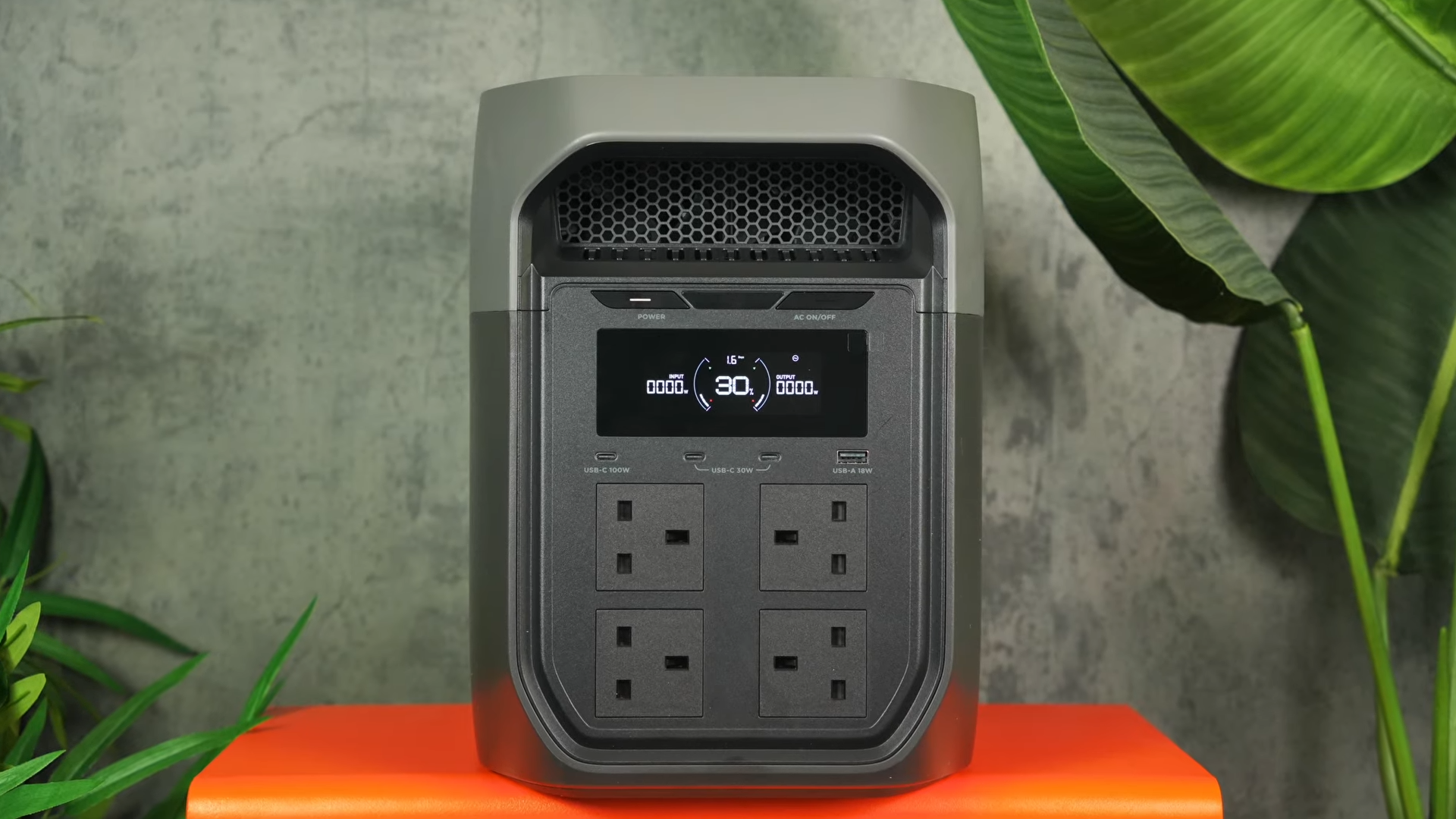
The front display screen serves as a highly functional control center, offering clear readouts of battery percentage, live power draw, and incoming charge rates. Having instant physical metrics means you do not have to rely constantly on a smartphone app to check system health. Dedicated, uncluttered physical buttons for the AC and DC channels make managing active power flows simple and intuitive.

Port Selection and Power Outputs
Power delivery relies on an array of well-spaced connections designed to handle multiple devices simultaneously. The front panel features four standard UK mains sockets, driving up to 2,400 watts of continuous power and a 4,800-watt surge threshold on the standard Delta 3 Max. Upgrading to the Max Plus model pushes those capabilities even higher to 3,000 watts continuous and a 6,000-watt surge limit.

USB connectivity satisfies modern charging requirements with high-speed Type-C ports capable of delivering up to 100 watts on the standard model, or 140 watts on the Plus variant. Standard USB-A ports remain available for legacy accessories, ensuring older gear is not left behind. On the DC side, a standard 12-volt car socket sits alongside smaller DC barrel outputs, which work beautifully for directly powering internet routers.
Input connections reside neatly at the rear of the chassis, keeping charging cables completely out of your primary workspace. The system supports mains charging alongside dedicated solar inputs, accepting up to 500 watts of solar power on the standard model and up to 1,000 watts on the Plus version. Utilizing solar input allows you to capture free daylight to offset grid consumption during peak hours.

Power Supply Performance
Transitioning this unit into a continuous home office backup system is made easy by its integrated transfer capabilities. EcoFlow specifies a rapid 10-millisecond transfer time, which effectively mimics an enterprise-grade uninterruptible power supply (UPS). While it may not match dedicated enterprise rack gear, the speed is more than sufficient to prevent critical office hardware from shutting down during sudden blackouts.
Testing this backup feature confirms that essential network hardware and desktop storage systems remain completely uninterrupted. Routers will not reset, and external hard drives will not suffer unsafe disconnections during power fluctuations. Operating the unit as a standalone generator remains an option, letting you charge it manually and deploy it only when necessary.

App Usability and Smart Features
Managing the system remotely relies on a highly polished companion application that ranks among the best in this hardware category. The user interface displays vital metrics clearly, giving you instant access to input rates, output draws, and precise runtime estimations. Scheduling features allow you to automate charging windows, enabling the battery to top up on cheap overnight tariffs and discharge during expensive peak hours.
Historic usage graphs provide direct insight into daily consumption patterns, helping you track exactly where your electricity goes. Navigating the application reveals a deep settings menu that occasionally feels slightly over-engineered. Certain advanced functions could benefit from clearer explanations, but the overall software experience remains highly stable and practical for daily monitoring.

Real-World Home Office Run Times
Assessing the daily performance of the 2,048-watt-hour battery involves running a standard remote work setup. My typical load consists of a MacBook Air, a single external monitor, an internet router, a desk lamp, and an iPad Pro, consuming between 70 and 90 watts. Factoring in natural inverter efficiency losses, this power station comfortably delivers around 20 hours of continuous operation.
Monitoring the discharge rate shows a predictable drop of roughly four percent per hour under an average 80-watt load. Working a standard eight-hour shift barely scratches the surface of the total capacity, leaving ample power reserves. This level of endurance ensures you can easily get through a full day of remote work without ever connecting to the grid.

Workstations and Appliance Load Testing
Stepping up to a more demanding workstation setup changes the battery consumption dynamics significantly. Powering a laptop dock, dual monitors, external audio speakers, and a network-attached storage (NAS) system pushes the continuous draw to around 300 watts. Under these conditions, real-world runtime drops to a range of 5.5 to 6.5 hours of continuous operation.

Supplementing the system with compatible solar panels becomes highly beneficial during these high-draw scenarios. Solar panels will not fully recharge the unit while you work, but they provide a consistent trickle charge that extends your runtime. High-wattage household appliances like kettles and microwaves can be powered easily, though they will drain the 2-kilowatt-hour capacity rapidly if used repeatedly.
Boiling a high-draw 2,000-watt kettle is fully supported by the robust inverter, but it serves as a stark reminder of energy consumption. You can expect to achieve roughly 14 to 16 kettle boils from a completely full charge before the battery depletes. This makes the unit an exceptional candidate for camper van conversions, where you run minor 12-volt electronics constantly and save the AC inverter for quick appliance tasks.

Charging Speeds and Solar Efficiency
Recharge speeds represent one of the most compelling advantages of this particular power ecosystem. Leveraging its fast-charging technology, the battery goes from zero to eighty percent capacity in approximately 50 minutes. Achieving a complete 100 percent charge takes just over an hour when connected to a standard mains outlet.
Solar recharging performance represents a slight compromise compared to other units within this specific size class. The standard model features a lower solar input ceiling, meaning it is not the fastest solar-charging machine available for the money. Utilizing solar panels is still highly effective for gradual top-ups, but relying purely on the sun for rapid turnaround times requires realistic expectations.

Final Thoughts — Price & Value
Investing in this power station represents a significant financial commitment that demands a clear use case to justify the cost. For remote workers trying to insulate themselves from blackouts or looking to capitalize on off-peak energy tariffs, the performance delivered is exceptional. The combination of reliable capacity, ultra-fast AC charging, and a polished software application positions it as a premium, highly capable desk-side companion.

Camper van builders and off-grid enthusiasts will find immense value in the robust continuous output, especially as an alternative to complex DIY electrical installations. Solar charging speeds could be faster, but the system handles heavy appliance loads and sustained office workflows with absolute ease. This unit stands as a versatile, well-engineered investment for anyone requiring serious portable power security.
